The Semisesquicentennial Man
Asimov’s Bicentennial Man, 50 years on
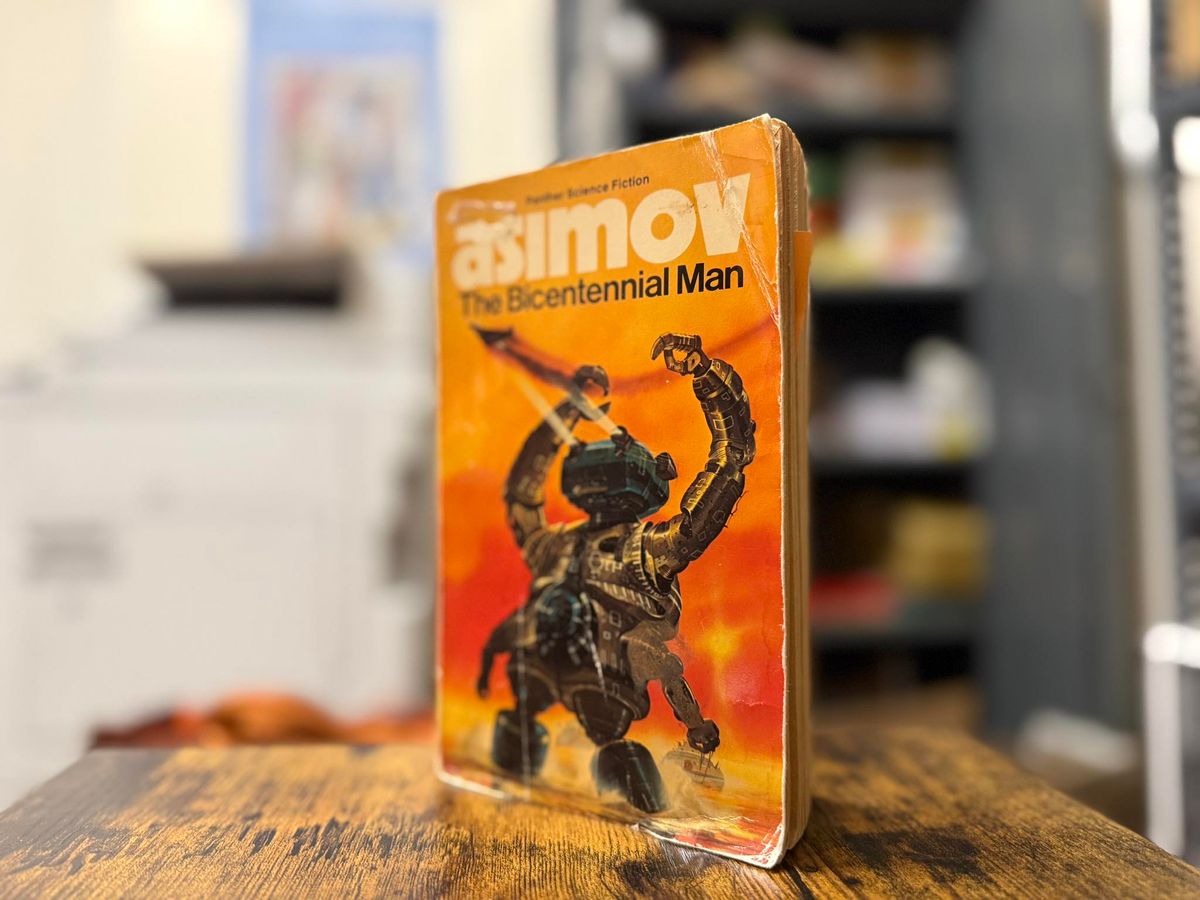
In January 1975, a science fiction fan named Naomi Gordon approached author Isaac Asimov with an idea: the United States Bicentennial was approaching, and to celebrate the occasion, she proposed an anthology that was built around the idea of “The Bicentennial Man”. It would be edited by well-known fan and editor Forrest J. Ackerman, and it would contain stories from a whole bunch of other well-known authors.
Asimov agreed to contribute a story to the effort, and set about envisioning a story around that core phrase. “It seemed to me that to avoid the actual 1976 bicentennial,” he wrote in his memoir It’s Been A Good Life, “I would need another kind of bicentennial, and I chose to deal with a two-hundredth birthday. That would mean either a man with an elongated lifespan, or a robot.”
He soon finished the story, but the project never materialized. “Naomi was beset by family and medical problems; some writers who promised stories didn’t deliver them; those who did deliver them did not turn out entirely satisfactory products,” he explained in The Bicentennial Man and Other Stories. He was eventually scolded by famed editor Judy-Lynn del Rey, who had once suggested an idea that was similar to what he ended up writing. “How is it that when you wrote a story for that anthology, yet when I ask you for one, you’re always too busy?”
When Asimov learned that the anthology wasn’t going forward, he returned his advance and turned it over to del Rey, who eventually published it in Stellar #2 in February 1976, just in time for the U.S. Bicentennial.
Asimov later noted that he considered it one of his finest shorter works, and fans agreed. The following year, it earned him a Hugo, Nebula, and Locus Award for Best Novelette.
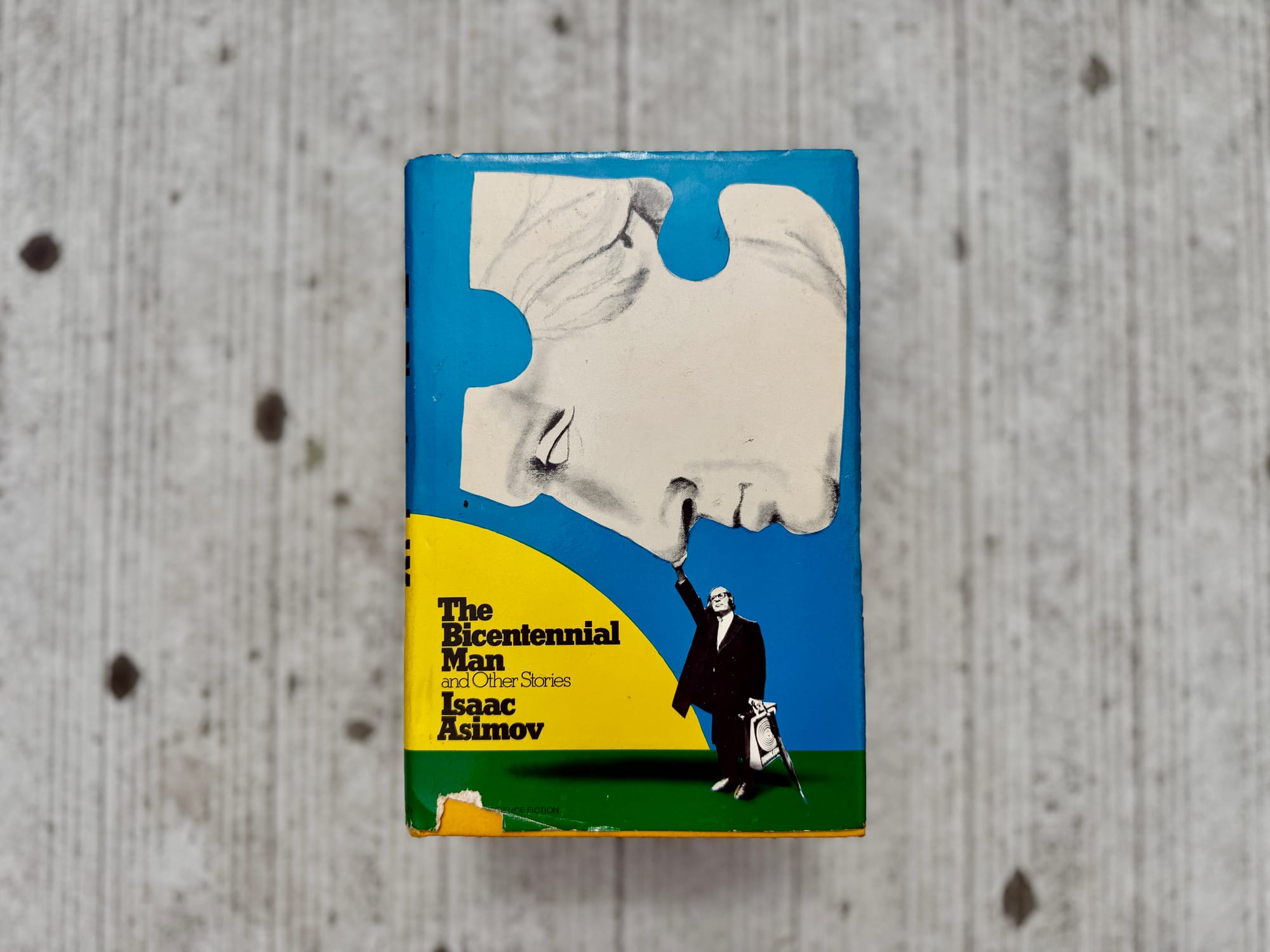
“The Bicentennial Man” opens with Andrew Martin speaking with a robotic surgeon about an upcoming procedure, one that the robot points out will certainly kill the patient, something it’s unable to do because it’ll violate the the Three Laws of Robotics. That won’t be a problem, Andrew explains: while he looks human, he isn’t.
From there, Asimov rewinds the clock two centuries: Andrew is an NDR robot purchased by the Martin family, who begins to display an unusual level of creativity and curiosity. They begin to think of him as part of the family, and they permit him to sell the carvings and woodworking that he begins to create.
When the family goes to his manufacturer, United States Robots and Mechanical Men, Inc., to find out why he has these particular abilities, they chalk it up to the complexities of the Positronic brains that their robots are equipped with and offer to replace him with a less defective model. The family refuses, and eventually set the robot up with a bank account for the money he earns.
From there, Asimov embarks on a moralistic thought experiment that pairs neatly with the ideals of the founding of the United States: what is the nature of freedom? When Andrew asks to buy his freedom from the family’s matriarch, he’s met with anger and frustration, but it kicks off a decades-long quest to understand the nature of liberty and autonomy.
He slowly works through the problems that face him: he’s bound by the constraints of the Three Laws — forced to obey orders by those who give them, and faces the threat of being dismantled — noting that while people can be executed after due process, there’s no such protections for him. He changes his appearance, upgrading his parts to better emulate the humanity he aspires to.
Ultimately, Asimov lands on the idea that life — at least life within the human society he envisions — is special because it ends, leading Andrew to take a final step: a last procedure that will sever his last connections to his robotic origins, at the cost of his life. On his 200th birthday, he’s legally recognized as a person — just before dying.
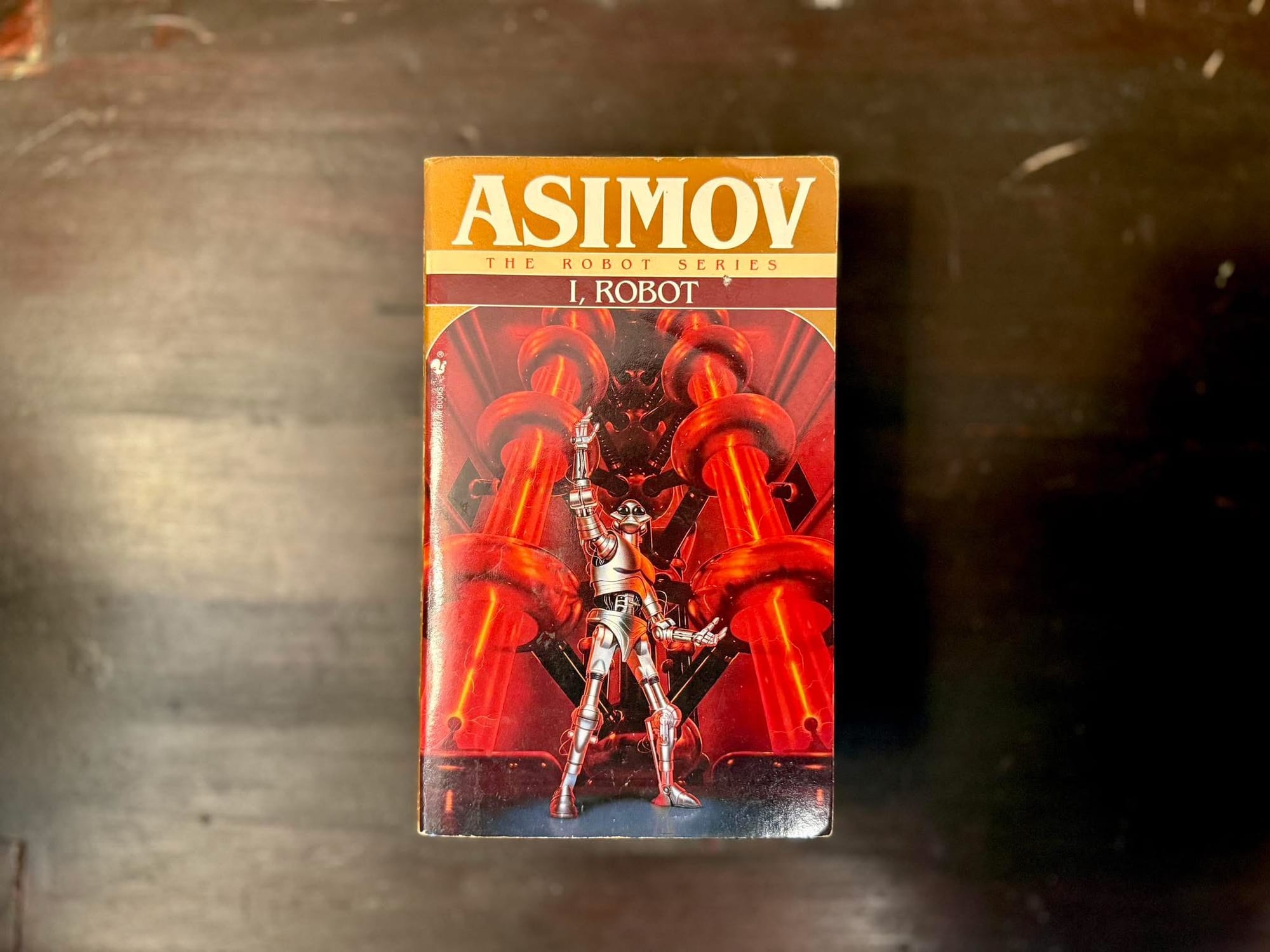
Asimov’s Robot stories are like little mental puzzles that seek to unwind a set of foundational constraints for his imagined future. He began tinkering with robotics starting in 1940 with his story “Robbie”, about a family robot that is owned by a family but eventually given up — only for it to be reunited with them when it saves the family’s young child from an accident.
He enjoyed the story, and decided that he wanted to write more of them, and brought an idea about a telepathic robot to his editor at Astounding Science Fiction, John W. Campbell Jr. The cantankerous editor sat him down and explained that they’d need some constraints to make the story work:
“Look, Asimov, in working this out, you have to realize that there are three rules that robots have to follow. In the first place, they can’t do any harm to human beings; in the second place, they have to obey orders without doing harm; in the third, they have to protect themselves, without doing harm or proving disobedient.”
That conversation proved to be the foundation of Asimov’s Three Laws, a logical set of safety constraints that would allow people to accept robots operating alongside them, and from the various exceptions and problems that arose from conflicts between those laws, Asimov pulled together a whole canon of short stories and novels that look at the nature of robotics and autonomy within society. With The Bicentennial Man, he tackled some of the biggest questions that faced his robots: just what was the purpose of robotics in society? What does freedom mean for a population designed and constructed to serve a specific role? And what happens when those individuals grow beyond those roles?
Written in 2026, I imagine that an author tackling Asimov’s Three Laws and the nature of robotics in society would draw on some very different inspirations, just as in this semisesquicentennial, we have a much greater understanding of the nuances and pitfalls that make up the American experiment.
Asimov’s robots never felt to me as though he thought to draw inspiration from America’s terrible history of slavery and the long shadow that it’s cast, nor does he ever really step into the discussion of the role of labor in a capitalist society. His robots just sort of … exist, as factory workers, laborers, and family servants alongside your idyllic, post-WWII American society.
But there are glimmers of some deeper thinking in the novelette: Asimov portrays the United States Robotics and Mechanical Men corporation as a somewhat shady company that’s more interested in trying to protect their bottom line from the possibility of distrust and over the two centuries that Andrew is alive, actively works to change out their products to be less reliant on individual robots in favor of a company offering up enterprise products. Science fiction has continually evolved in the last 50 years, movements like the New Wave and Cyberpunk have added depth and nuance to those themes and ideas that Asimov never really considered.
 Andrew Liptak
Written today, “The Bicentennial Man” would have looked very different, but gliding along the same rails: what is the price and nature of freedom? How is it granted with society? How do people — even those with good intention — end up providing friction and outright opposition to it?
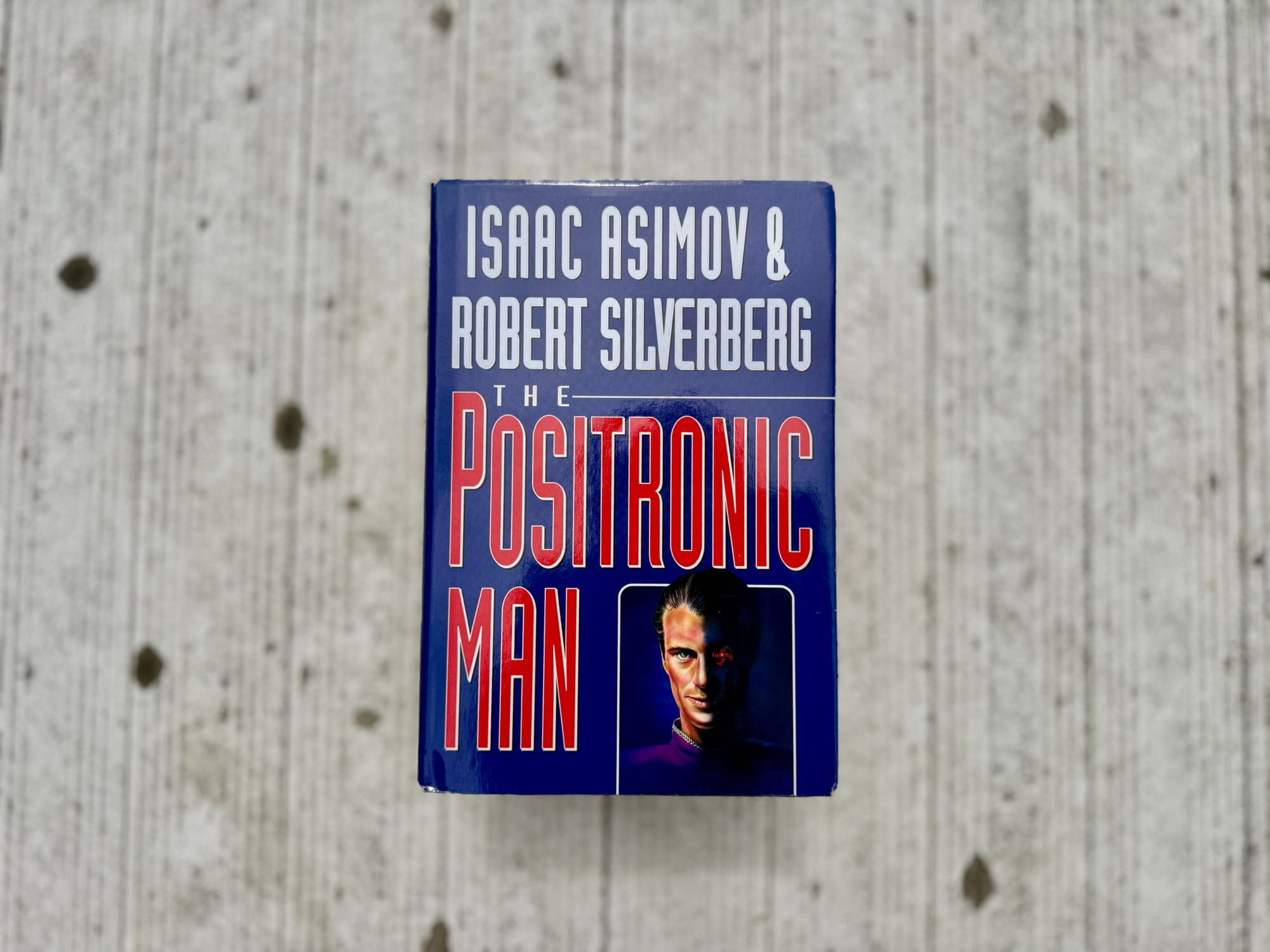
“The Bicentennial Man” wasn’t the end for this particular story.
Asimov had taken a long break from science fiction before being enticed back in the 1980s for a new novel. His editor at Doubleday, Betty Prashker, met with him and said that they would like to get one from him, a demand that he tried to push back on. That evening, he got a phone call from the publisher’s science fiction editor, Pat LoBrutto: “Listen Isaac, let me make it clear. When Betty said ‘a novel’ she means ‘a science fiction novel’; and a when we say ‘a science fiction novel,’ we mean ‘a Foundation novel.’”
After demurring for a bit — and after getting an advance — he reread his Foundation trilogy and realized that he began working on what would become Foundation’s Edge, and after it became a bestseller when it was released in 1982, he continued the series, eventually uniting his Foundation and Robot stories together.
“Isaac was getting old and not in the best of health,” Robert Silverberg explained to me in an email, “and Doubleday was nagging him to do more novels, since he had had a series of recent best-sellers.”
Asimov had some other ideas that he wanted to work on, so editor Marty Greenberg proposed an idea that would help get more novels: take three of Asimov’s novellas and expand them into novels. Silverberg and Asimov had been friends for decades at that point. “Isaac and I were friends from the time we met at the 1955 Worldcon and we saw a great deal of each other between the time he moved from Boston to New York and I moved, years later, from New York to California.”
“He saw me as a sort of junior version of himself — bright Jewish kid from Brooklyn who went on to Columbia University and began selling stories at a very early age, same life and career paths fifteen years apart.”
It was a natural pairing, and as Silverberg was going through a divorce, he needed some reliable income. “Isaac agreed, my agent sold the three books to Doubleday for a spectacular advance, and I paid off my divorce with the proceeds of my share.”
From there, they got to work. “For the first book, Nightfall, I worked closely with Isaac, questioning him about various details of the cosmic setup that is the basis of the story,” Silverberg wrote. “Then I showed him my draft; he was very pleased with it. made just a few suggestions for revisions.”
Nightfall came out in 1990, and they proceeded with the same process for the second project, The Ugly Little Boy: Silverberg questioned him and set about writing, shared his draft, and made corrections.
By the time they embarked on the third book, Asimov was ill: he had contracted HIV from a blood transfusion during bypass surgery in 1983. Over the years that followed, he his health began to decline, and it wasn’t until another surgery in 1990 that he was tested and diagnosed with the illness. In April 1992, he died, never seeing the expansion that Silverberg had been working on. “What makes it all the more poignant is that the story is about a robot who wants to prove that he’s human by dying,” Silverberg explained.
The novel was eventually optioned for a feature film adaptation. Written by Nicholas Kazan and directed by Christopher Columbus, the film starred Robin Williams as Andrew, and follows him across the centuries as he slowly becomes more and more human. Silverberg described it as “about half of the script was a faithful adaptation of my expansion of Isaac’s story,” with the rest taking some unfortunate liberties and divergences. It’s a fun, goofy film — one that feels ripe for a revisit, especially in an age of artificial intelligence.
Rereading “The Bicentennial Man” this Independence Day weekend, I was struck at how Asimov conveyed a story that stretches across two centuries. He’s often played with vast stretches of time in his stories: “Nightfall” is all about an episode of destruction in a cyclical cycle, while Foundation is about the fast destruction of an Empire that takes place across centuries, and “The Bicentennial Man” is a quieter exploration of change: changes in attitudes, in culture, and desires, all underpinned by the unchanging idea that the pursuit of freedom never ends. It’s a fitting message at a chaotic time, when it feels as though we’ve lost our way in the world. Hopefully, it can serve as a reminder that we live in an unfinished state, and that the journey is what makes it worth accomplishing.