Apple will adapt Brandon Sanderson's Cosmere universe
Another big adaptation from Apple
There must be someone in Apple's streaming division who's really into science fiction and fantasy novels. Since it launched, it seems as though the company has been focusing on good storytelling over catalog size, and when they've been adapting existing genre books, they've been picking out some big names: Isaac Asimov's Foundation, Hugh Howey's Wool, Martha Wells' Murderbot series, Lauren Beukes' Shining Girls, and William Gibson's Neuromancer. This week, word broke that the company is adding another heavyweight author to the mix: Brandon Sanderson.
Per The Hollywood Reporter, Apple has signed an "unprecedented" deal for his Cosmere universe, in the form of film adaptations for his Mistborn novels, and a television series for The Stormlight Archive. Sanderson will have "rarefied control" over the adaptations, and "will be the architect of the universe; will write, produce and consult; and will have approvals" – privileges that THR's Borys Kit says that not even George R.R. Martin or J.K. Rowling enjoy.
This is a huge get for Apple, which hasn't really dipped its toes into the epic fantasy scene yet. HBO has its Westeros franchise (Game of Thrones, House of the Dragon, and A Knight of Seven Kingdoms), while Amazon has Lord of the Rings: The Rings of Power and had The Wheel of Time and Netflix has The Witcher. There's some dithering you can make about their respective qualities and impact, but collectively, they're big, enormous projects that have the potential to really make an impact on the cultural zeitgeist.
Sanderson is as big as you can go these days, and his Cosmere novels are not only big in size and scope, but they come with an enormous fandom.
This is the type of piece that Transfer Orbit's supporting members regularly get: a deep-ish dive into genre news that seeks to go a little beyond the standard "this is what happened" post.
They're designed to inform and provide context for why this sort of news matters, and if you want to help ensure that these pieces come out, please consider signing up as a member!
Cosmere
Sanderson's began writing consistently while attending Brigham Young University (BYU) as an English major in the late 1990s: he wrote a novel called Dragonsteel for his Master's degree, and published his first novel, Elantris, in 2005. From there, he continued to write: he published Mistborn: The Final Empire the following year, and The Well of Ascension in 2007 and The Hero of Ages in 2008.
Early on, Sanderson was determined to make sure that his books fit together into a cohesive world. Inspired by author Isaac Asimov, who wrote two series, Foundation and Robots and later brought them together, he explained that it was probably better to build that into his plans from the onset. Cosmere isn't so much an ongoing series as it is a world: they share a broad mythology, but can stand on their own. Elantris, Mistborn, Well of Ascension, and Hero of Ages all fell into that larger world.
As he was doing this, he attracted the attention of Tor Books editor Harriet McDougal, who was married to fantasy author Robert Jordan. Jordan had been diagnosed with a terminal illness and was working to complete his own epic fantasy series, The Wheel of Time, ultimately putting together reams of notes in case he ran out of time. McDougal was impressed with Elantris and invited Sanderson to complete the series after his passing: the last book became three: The Gathering Storm, Towers of Midnight, and A Memory of Light.
The Stormlight Archive
His work on Wheel of Time helped bring him to a much greater audience, and he turned his attention to his own fantasy epic, The Stormlight Archive. This was a series that he had been planning for years: he began writing it in 2003, and after writing and re-writing, he eventually published the first installment in 2010: The Way of Kings, a novel set on a harsh world called Roshar, and in which humanity endures constant threats from monsters known as the Voidbringers, and who've set up the Knights Radiant to protect them.
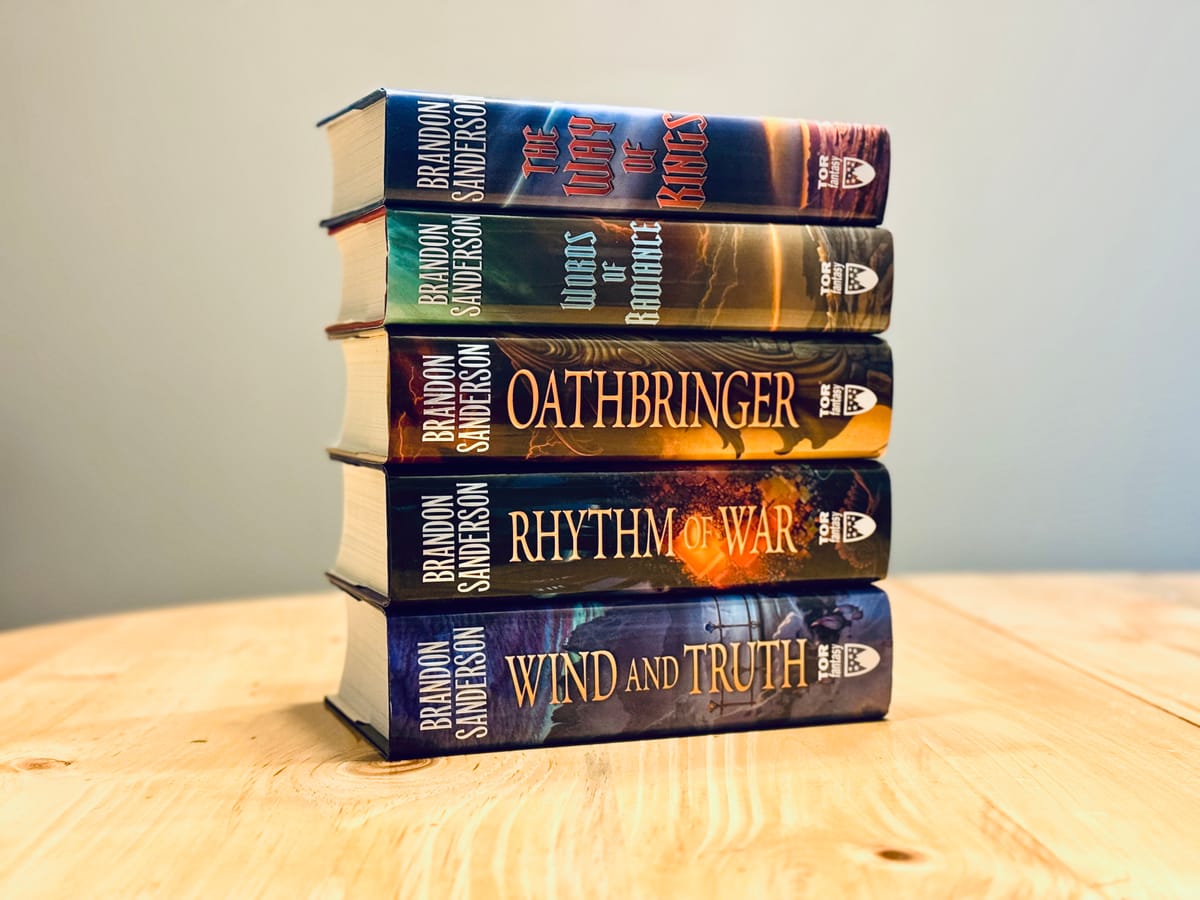
This is a massive novel in the tradition of Robert Jordan and George R.R. Martin: it's loaded with intersecting characters and lands, an elaborate magical system, and a long-running plot that Sanderson has said will run across ten novels. In 2024, he published the second installment, Words of Radiance, and followed it up with Oathbringer (2017), Rhythm of War (2020), and Wind and Truth (2024), which made up the first arc of the epic.
Along the way, he's published a number of other novels, some set in the broader Cosmere world, such as Warbreaker (2009) and Mistborn: The Alloy of Law (2011), as well as some that stood on their own. In 2022, Sanderson revealed that he had written four novels during the COVID-19 lockdowns, and was going to publish them directly via Kickstarter, which included three Cosmere novels (Tress of the Emerald Sea, Yumi and the Nightmare Painter, and The Sunlit Man). Another novel in the world, Isles of the Emberdark, is due out next week.
The Adaptations
There's been good amount of interest over the years in adapting Sanderson's books: in 2016, Variety reported that he had signed a huge deal for an adaptation of the Cosmere universe with DMG Entertainment, a US-based studio with a particular focus on the Chinese market. At the time, the plan was for a series of adaptations, starting with The Way of Kings (screenwriters Patrick Melton and Marcus Dunstan were tapped for the project) to be followed by an adaptation of Mistborn.
Not long after, DMG announced it was spending a significant amount of money to produce a unique pitch for the projects: a 15-minute VR "experience" drawn from The Stormlight Archives, which would help demonstrate the look and feel of the world. It eventually released a look at the experience in 2018, and my colleague Chaim Gartenberg, noted at the time that it was a pretty faithful depiction of the world: "as someone who’s a fan of the series, it’s pretty great to see and experience some of the magic and locations from the novel, most of which have never had any real visualizations before beyond what I’ve imagined in my head."
The same year, Sanderson published his annual end of the year "State of Sanderson" roundup, in which he noted that things were moving along smoothly: the studio had commissioned scripts adapting The Emperor’s Soul, Mistborn, and The Way of Kings, and had been working on pitching those projects to various studios, particularly a film series based on Mistborn and a TV series of The Way of Kings.
He reported slow and steady progress over the next couple of years: he stepped in to write treatments and as of 2024, it looks like Mistborn got pretty far along but ended up getting set back to square one, and it looks as though DMG ended up dropping the property altogether. In December, he hinted that there was news coming: he had been making pitches to studios starting in May, and that things looked promising.
As it turns out, Apple was one of the studios that was interested, and in a post on Reddit, Sanderson explained a bit more of the timeline: he had begun looking for a new partner in May, and that this time, he was being courted by a number of high-level executives. "Not just producers or low level executives. And this led to some really tough choices. I got the red carpet treatment, and liked everyone I met."
Ultimately, he went with Apple, saying that he was pleased with two things: the level of control that he'd get to have over the project, and their track record of quality programming. "I find virtually every thing of theirs I watch is excellent and creator driven." It looks like it'll be a major focus for him, and he says that he'll be devoting much of this year on writing the screenplay for Mistborn, to the point where he's setting aside work on the various novels that he has in the works at the moment.
There are a couple of things jump out at me about how this has progressed. First, Sanderson has enjoyed a pretty incredible career so far, and along the way, he's been able to really leverage a the opportunities that have come his way: getting plucked out of the pack to finish A Wheel of Time brought him a ton of name recognition, and his Stormlight Archive series has been steadily growing as he's been producing them. The Kickstarter project also seems to have had a huge knock-on effect: at nearly $42 million, it's currently the second biggest project ever on the platform's history, and while that undoubtably introduced him to a ton of new people because of that news, it also helped him build a company around his books.
In that time, he was also somewhat involved in Prime Video's Wheel of Time adaptation as a producer. I don't know to what extent he was involved in the day to day (it doesn't sound like much), but that, combined with the grind of pitching films and shows to Hollywood seems to have really given him a good idea of how the industry works, and that's something that he's used to his advantage this next go-around. While DMG doesn't appear to be involved in this new iteration of the project, it does seem to be following some of the same goals: a film series for Mistborn and a television series for Stormlight Archive.
Something that's impressed me with Sanderson is how he's been able to build a community around his books and the larger Cosmere world. It's a world that – much like other settings, contains depths and space for fans to engage with the lore, characters, and story, and keep them coming back over and over again. He also engages with those fans a lot: he's constantly on the road, holds an annual convention, and provides a lot of updates about his work and what he's up to on online through platforms like Reddit and his blog.
All of those factors have put him in a good place for a deal like this: it's clear that he's got a good team behind him to handle the management and logistics for getting his stories out to bookstores and reader, and he appears to have a clear vision for what he wants adaptations of those stories to look like.
And, it seems that for all of the talk about the streaming wars coming to an end with consolidation and the pullback of big budget projects, there's still an appetite from places like Apple for a big swing like this. A fantasy television project – especially an ambitious one like The Stormlight Archive, is no small undertaking: it requires extensive behind the scenes work to mount these types of productions, and up until this point, most haven't really been able to justify those costs: using these projects to goose subscriber growth seems to have hit a ceiling.
I've always seen Apple as being something a little different from places like Netflix or Warner Bros.: Steve Jobs instilled a deep industrial culture of focusing on quality, something that you saw with his involvement at Pixar (I highly recommend checking out Creativity, Inc.: Overcoming the Unseen Forces That Stand in the Way of True Inspiration by Ed Catmull and Amy Wallace for some insights there), and it feels like at times that most of the metrics that streaming services seem to live or die by take a second seat to devoting time and energy into producing something that's really good.
That seems to have convinced Sanderson that Apple was the right home for this, and that the wild popularity of his works will eventually translate into a solid offering to expand the company's suite of services and products on the creative side. Undoubtably, it'll be a while before we see anything – if it gets to the point where cameras start rolling.
Update, 2/3/2026: Sanderson rolled out a short video about the deal, and noted something that didn't come out elsewhere: he's looking to be showrunner / co-showrunner on the projects.