Imagining the breakdown
May and June 2021 brought with it reports of several significant cyberattacks against a handful of US businesses. A handful of novels have predicted this will be a growing national security issue.

The last couple of weeks have brought a long-simmering national security issue to the forefront: cybersecurity vulnerabilities in the form of ransomware demands against some major companies throughout the United States.
There was the Colonial Pipeline attack at the beginning of May, which put a stop to a key fuel pipeline, which prompted some panic buying throughout the United States. Yesterday, there was a trio of other attacks: Steamship Authority of Massachusetts revealed that its ticketing and website operations were knocked offline, while The New York Times revealed that a Chinese hacking group breached the MTA's computer systems, and on Tuesday, the US's largest meat producer, JBS, shut down all of its plants after a ransomware attack.
There have been warnings — and some misfires — about the security of the nation's power grid and electoral system, but this latest slate of attacks highlights something that national security professionals have been warning about for years: the US's technological infrastructure is vulnerable to such attacks.
What these incidents have also shown is that they don't have to result in death and destruction to cause significant problems for people around the country. Following the Colonial Pipeline attack, drivers around the US began hoarding gas — sometimes resulting in fights between drivers — prompting the Consumer Product Safety Commission to warn people against filling plastic bags with gasoline. Officials warn that the JBS disruption could result in a spike in meat prices. Taken separately, they're issues that authorities can deal with: with a growing number that target a handful of industries and products, a foreign adversary can cause widespread disruption and harm.
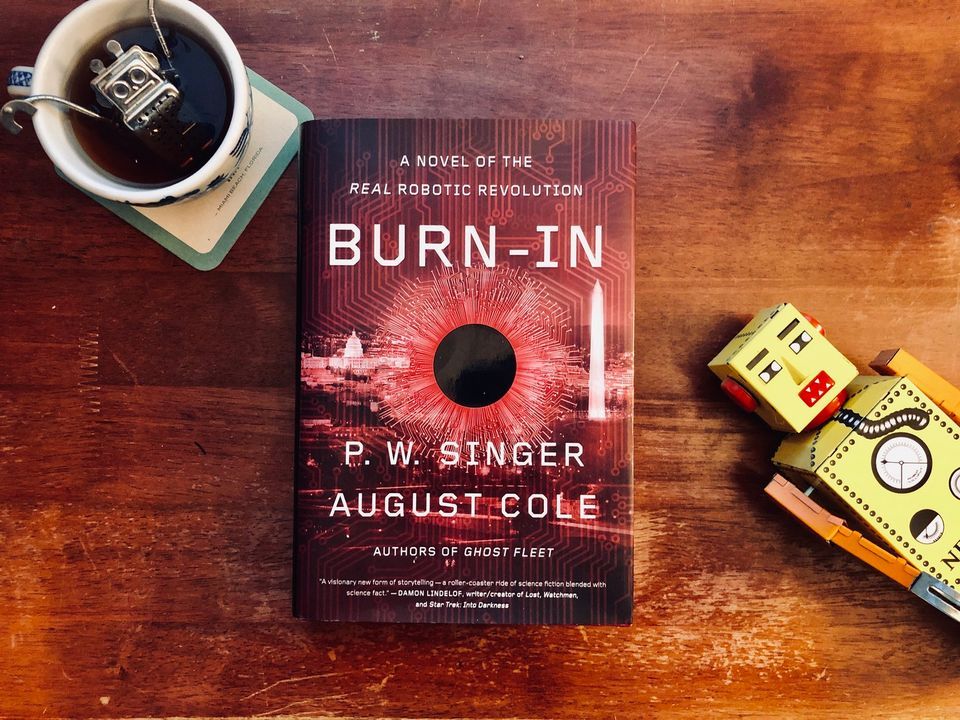
Some of those warnings have come in the form of fiction. Earlier this week, author Peter W. Singer pointed out that the JBS hack was something literally out of science fiction: his own science fiction:
“Cyberattack hits world's largest meat supplier”
— Peter W. Singer (@peterwsinger) June 1, 2021
Literally page 231 of #BurnInBook coming true
(And no, this was not part of our paperback release week promotional) https://t.co/2WD2T3ob5j
The scene in question:
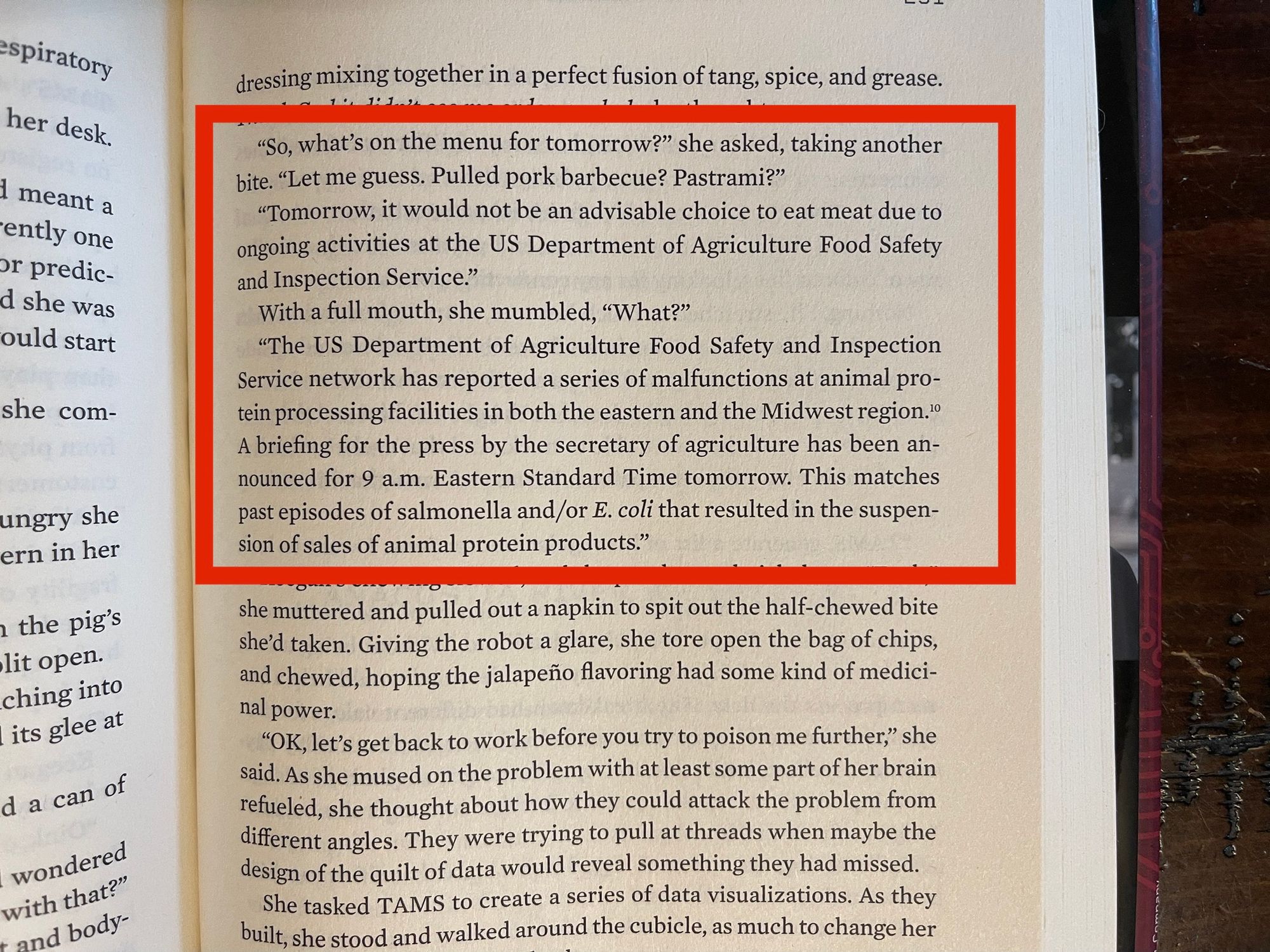
I'm assuming that Singer and his co-author, August Cole, aren't running some sort of elaborate marketing campaign, given that the book's paperback edition just came out. (You can find my review of the book here.)
Burn-In is the pair's take on what they've called FICINT or "useful fiction" — stories that are explicitly designed to explore the ramifications of policy and technology decisions, using fiction as a way to drive home the possibilities of where technology can break down — and where that can represent a threat to the nation's security.
The book is set a couple of decades from now, in which an FBI agent named Lara Keegan is tasked with taking an experimental robot out for a spin: TAMS (which stands for Tactical Autonomous Mobility System) a robot that is designed to be an assistance to officers in the field — it can make decisions quickly and access a lot of data through machine learning, and the pair find themselves on the trail of an anti-technology extremist who has begun to carry a series of bible-inspired attacks against Washington DC.
A critical point in this story is the weakness of the plethora of automated systems throughout the city: everything from the city's water management systems the power grid, and how those weaknesses can be exploited by a dedicated adversary. Singer and Cole go a bit further than that as well, exploring the underlying social conditions that are primed for violence: the rise of right-wing extremism and social engineering that underlies plenty of automated systems.
What the book illuminates is how these threats aren't just plausible because someone opens an email or downloads something that they shouldn't: it highlights how existing unreast and problems simply act as a force multiplier. Sure, you can shut down a gas pipeline and people will freak out. But what if you shut down that pipeline in the midst of a toxic atmosphere of gun ownership and angry white people who think that an election has been stolen from them? The point that Singer and Cole make is that the technological and social are inherently linked, and that there are weaknesses in a national defense not only when you have weak or non-existent defensive systems and policies, but also when you have widespread, systemic unrest.
That all seemed extremely plausible when the book came out — it's a little strange to see it playing out in the real world already.
This is territory that Singer and Cole have played with before: their 2015 novel Ghost Fleet played with similar topics, again focusing on the insecurities that we have in the technologies that we depend upon. In that instance, they look at the future of warfare, and look at a future where the US, China, and Russia go to war, and in which the US is delivered a stunning blow when backdoors baked into various military hardwares are exploited by the Chinese military, allowing them to put most of the US's advanced arsenal out of commission.
The pair are also not the only ones to focus on this: Eliott Ackerman and Admiral James Stavridis's 2034: A Novel of the Next World War opens with the US Navy going toe-to-toe with a Chinese fleet, which is essentially able to flip the off switch on those ships, allowing them to destroy them quickly. At the same time, China hijacks an F-35 fighter jet and guides it and its hapless pilot to an Iranian airstrip, setting off a further diplomatic crises for the country.
Technological insecurities have long been a staple of science fiction: just look at 2001: A Space Odyssey's Hal, which is able to undermine a space mission because of how it interprets its instructions, while the Syfy Channel's Battlestar Galactica reboot opens with the premise that advanced technologies might be useful, but they can also be undermined if you're not prepared for the proper angle of attack. What good is an advanced piece of military hardware if you can't get it to turn on or function?
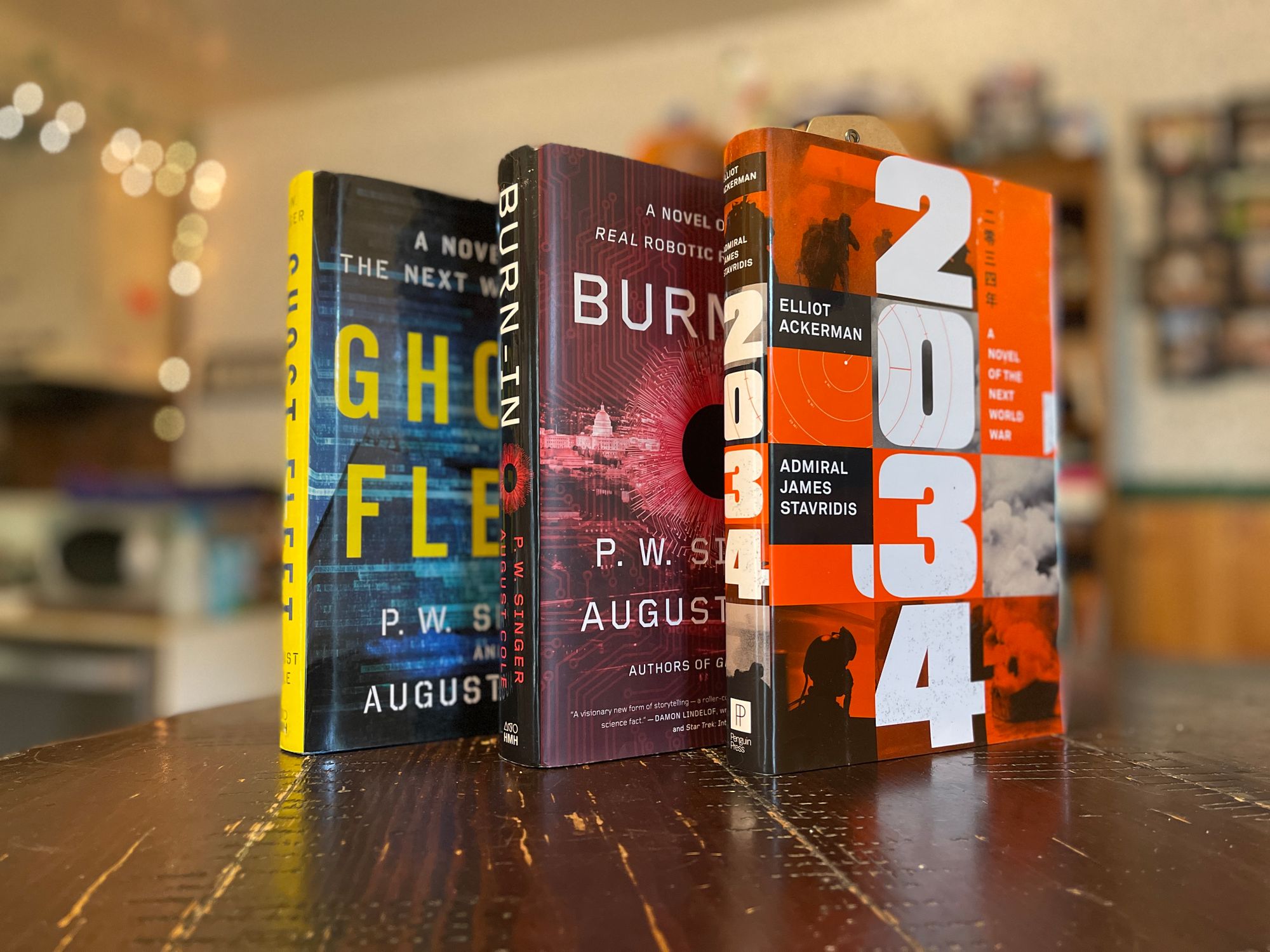
These are questions that Singer, Cole, Ackerman, and Stravridis are playing with in their respective books: they're a warning couched in fiction to policymakers about the threat that overlooking cybersecurity poses for everyone. It takes an intangible concept and turns it into something that we can grasp. What's scary is when those science fictional concepts play out in real life.