Mythological contacts
Daniel H. Wilson's Hole in the Sky is a tense, gripping thriller about first contact
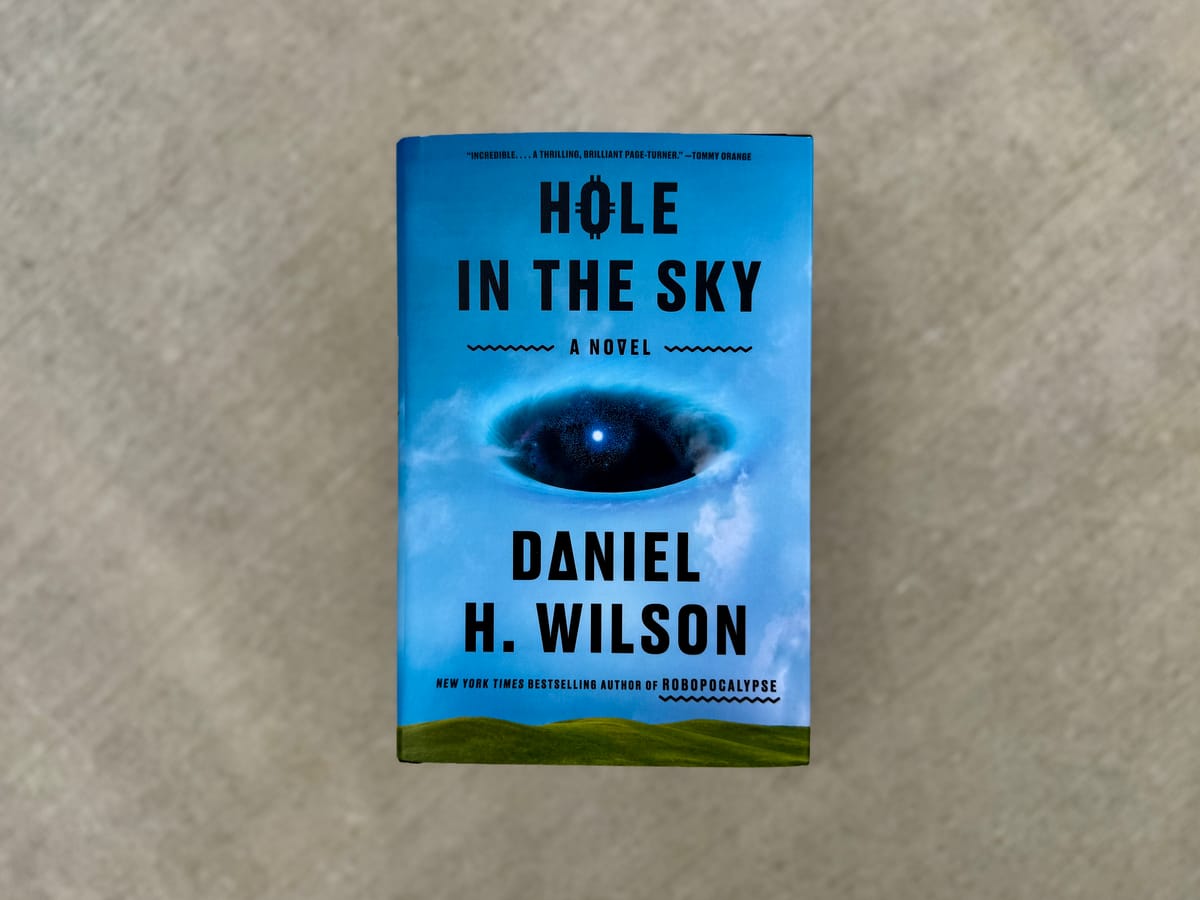
First contact is one of those genre tropes that's been around for almost as long as science fiction has been around, and it's often a mask for contemporary concerns. I've often viewed H.G. Wells' War of the Worlds as a good litmus test for these types of stories: his home country of England can easily stand in as the alien invaders for peoples across the world. In the years since, we've seen no shortage of similar stories about aliens coming to Earth for various purposes, sometimes to warn us of the consequences of our more violent tendencies (as in The Day the Earth Stood Still) as conquerors (Battle: Los Angeles, Independence Day, James S.A. Corey's The Mercy of Gods, or Marko Kloos's Frontlines series), assimilators (Childhood's End), researchers (Close Encounters of the Third Kind), unfortunate encounters (District 9 or The Thing), or just didn't even notice us as they passed through (Roadside Picnic).
It's a well-trod space, and as such, it's sometimes hard to break through with a new take on it: how many times can you blow up a landmark or dislodge troops without a viewer or reader realizing that they've seen this before? Daniel H. Wilson's new novel Hole in the Sky does just that, not only by spreading out the action across a handful of characters, but also by putting an indigenous spin on it. The result is character-driven and cinematic technothriller that gripped me to the end.
Wilson opens with an anonymous engineer who stumbled upon a weird phenomenon with a throwaway project generating poetry that ends up predicting future events and incidences. It's quickly cooped by the military, who lock this hapless guy ("the man downstairs") and begin to act on the things that his algorithm is predicting. 12 years later, it yields its most chilling prediction to date: "An eye opens in the deep": we've caught something's attention, and it's now looking our way.
From there, we're off to the races as the world begins to realize that something is coming our way. We follow Gavin Clark, a member of the military's Emerging Weapons Technology Group, as he jets around the world to examine Unidentified Anomalous Phenomena (the more serious rebrand of the classic UFO) sightings, noting an uptick that has him concerned. Meanwhile, NASA mathematician Mikayla Johnson, who wears a set of AR glasses, detects that the Voyager 1 and Voyager 2 probes have just passed something in the depths of space and when she decodes the data, she finds a distressing message: horrifying screams. And over in Oklahoma, we find Cherokee oil worker Jim Hardgray, who's just reunited with his estranged daughter Tawny.
These three characters all see that something strange is happening: Gavin's been studying and preparing for otherworldly threats for his whole career; Jim and Tawny begin having visions connected to their indigenous heritage, while Mikayla is more than ready for first contact: she has trouble connecting with people and feels as though she's ready to leave this world.
They're all coming to terms with this entity in their own way – wonder, caution, excitement – as it's zeroing in for a landing at Oklahoma's Spiro Mound complex, the remains of a prehistoric Native American culture that dates back millennia. This is where the novel really shines: Wilson melds his alien encounter with elements of Cherokee cosmology – the Pleiades cluster holds special significance – imagining that those mythologies have real, extraterrestrial significance.
It's an apt combination, and Wilson has spoken in interviews about how these sorts of invasion stories take on a particular grim significance through an indigenous lens: you don't have to do much to reimagine the the post-Columbian era of North America as malevolent first contact story. As this mysterious object reaches the Spiro Mound and our characters come up close and personal with what it's brought, we see just how scary this sort of contact can go.
In Wilson's hands, we're also examining our own assumptions about the nature of intelligence and civilization, of science and mythos, and how these seemingly different things could really just be one and the same: the ancient stories that Jim's ancestors were passing down turn out to be less fictional than anyone could have imagined. It's how we approach the unknowns of the world and the way our assumptions shape our reality that guide how our characters – and readers – approach this world-changing event. It's this approach, blending day science and the deeper cosmology and storytelling that elevates this novel in some unexpected ways, yielding a gripping and thoughtful view of our place in the cosmos.