Dune: Part Three teases a grim future for the galaxy
The film hits theaters on December 18th
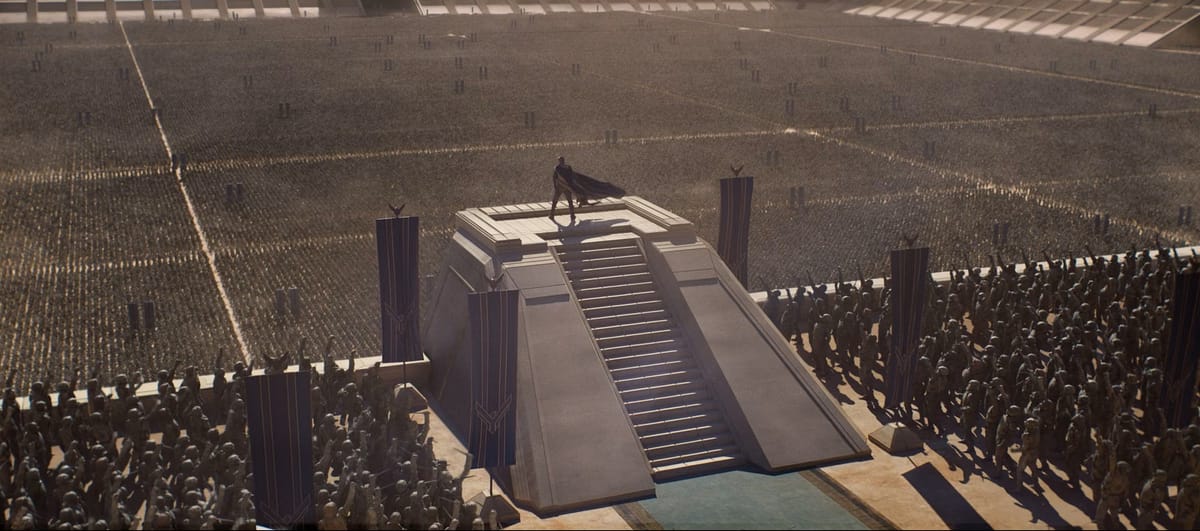
Warner Bros. has dropped the first teaser trailer for Denis Villeneuve's Dune: Part Three. The film is being billed as the "epic conclusion" to the Dune saga and adapts Frank Herbert's novel Dune: Messiah, picking up the story of Paul Atreides 17 years after the events of the last film as he figures out how to navigate his existence as leader of the Fremen and galaxy while also protecting his family.
There's a lot to take in here: glimpses of the ongoing, genocidal war that Paul has instigated, of the threats that other powers in the galactic hierarchy that are threatening to topple him, and conflicts within his family that could undermine everything. It looks as though this'll be a much darker film.
Here's the trailer:
Dune: Messiah is a really interesting novel, and it looks like this is going to be a really intriguing continuation from the first films. Speaking on a live-stream ahead of the teaser's release, Villeneuve noted that this film is "a very different movie than the first ones. It’s a good idea to come back to those world, not by nostalgia, but by urgency. If the first movie was contemplation, a boy exploring a new world, and the second one is a war movie, this one is a thriller. It is action-packed and tense.”
That's fitting, because the novel really takes the story of Paul and upends everything, turning into a real meditation on what power does to a person. It's going to be really, really interesting to see how audiences respond to this film, because it's going to take Paul to some unexpected places.
Dune: Part Three finishes off part of the story that Villeneuve began in 2021 with Part One and continued in 2024 with Part Two. Those first two films did what had stymied filmmakers for decades: successfully adapting Frank Herbert's epic – and dense – space opera for cinema. While he adapted the first book in two parts, this third part moves onto the next book in the series, Dune: Messiah, a radical take on the story that angered its original editor so much that he refused to publish it.
 Andrew Liptak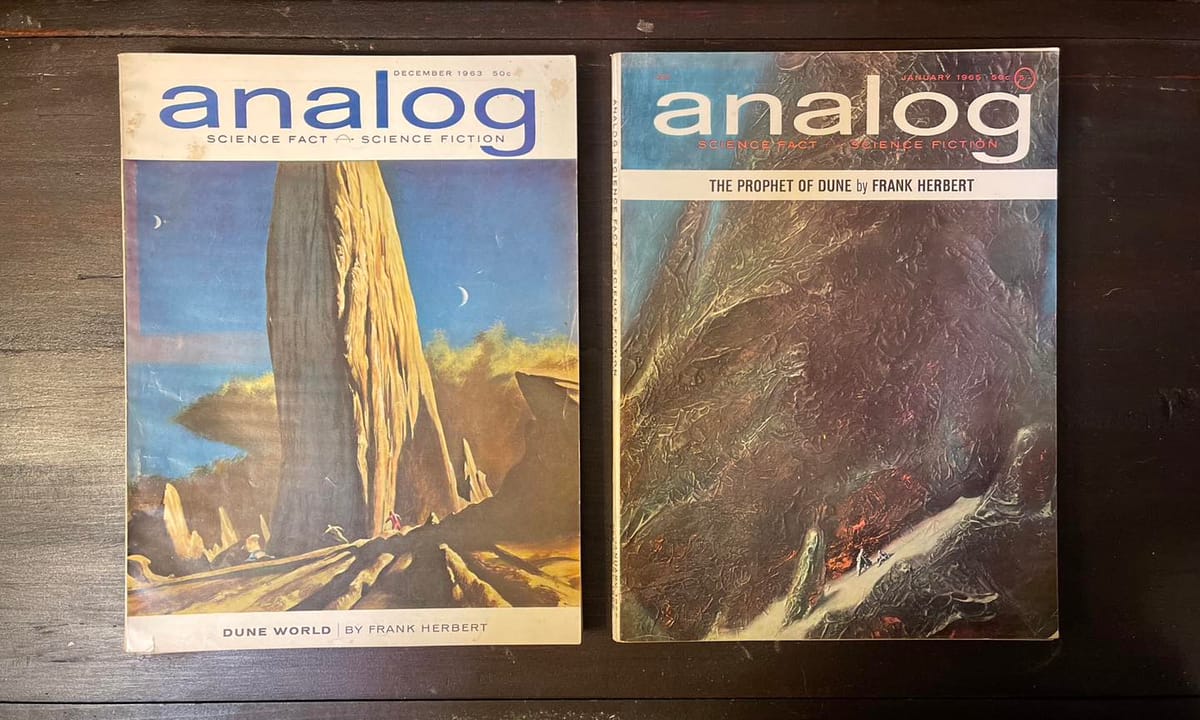
Herbert originally serialized Dune World in Analog Science Fact and Science Fiction, starting in December 1963, and after a little trouble, published Dune through Chilton, a publisher traditionally known for its car manuals, in 1965. While not initially a hit, it soon found an audience in the counter-culture movement Ace published its edition in 1967.
The novel follows a young noble called Paul Atreides, whose family is assigned as caretakers for a desert planet called Arrakis. Shortly after they arrive, a rival family called the Harkonnens retakes the planet and kills his family. Paul and his mother are forced to flee into the planet's deserts, where they link up with the native Fremen, who believe that Paul is a Messiah-like figure called the Lisan al-Gaib who was foretold to will help them free the planet.
Paul has some innate psychic powers, the product of a generations-long breeding program from an order known as the Bene Gesserit, and can see into the future. He has some frightening visions: he'll lead the Fremen to victory, but in doing so, will unleash a jihad that'll consume the galaxy, killing tens of billions of people. He ends up taking up the mantle of the Fremen to retake Arrakis, and ends up kicking off that galaxy-wide genocide. Paul, as it turns out, was never really a hero, but a cautionary tale.
That's where Herbert picks up the story with the second installment: Dune Messiah. It's set 12 years after the events of Dune, and Paul has now maneuvered himself to rule the galaxy from his seat on Arrakis. The jihad that he envisioned came to pass, and he's realized that he's powerless to stop it, even as he sees that the outcome could have been much, much worse.
He's now trying to put humanity on to a firmer path that won't lead to a galactic-wide decline and dark age, and now faces considerable threats from within his own world: he married the Princess Irulan, daughter of deposed Padishah Emperor Shaddam IV in a political marriage, who's been sabotaging his efforts to have a child with his lover and concubine Chani, while members of the Spacing Guild and the Bene Gesserit, have been trying to topple him.
When he published Dune through Analog, his editor John W. Campbell Jr. was thrilled at this story that ultimately comes down to a superhuman, heroic figure, writing to Herbert "Congratulations! You are now the father of a 15-year-old superman!"
But Herbert wanted to break away from the traditional story of heroics that Campbell was so keen on, which Haris Durani described as "a “western” notion of the myth of individual triumph, as opposed to stories of broader social, collective movements."
Instead, he flipped the script by turning Paul into an anti-hero: "it’s my contention that the difference between a hero and an anti-hero is where you stop the story," Herbert told Willis E. McNelly in 1969. "If you’re true to life, giving these ingredients, then the story goes on, because human beings go on."
The move prompted Campbell to reject the next arc that would eventually become Dune: Messiah. Herbert instead sold it to Galaxy Magazine, which began serializing it July 1969, and G. P. Putnam's Sons, which published it in October.
Herbert later wrote and spoke quite a bit about his approach and beliefs here: he was very wary of the power that charismatic leaders wielded – power that the people they represent give to them: "personal observation has convinced me that in the power area of politics/economics and in their logical consequence, war, people tend to give over every decision-making capacity to any leader who can wrap himself in the myth fabric of the society. Hitler did it. Churchill did it. Franklin Roosevelt did it. Stalin did it. Mussolini did it."
"Don't give over all of your critical faculties to people in power, no matter how admirable those people may appear to be. Beneath the hero's facade you will find a human being who makes human mistakes. Enormous problems arise when human mistakes are made on the grand scale available to a superhero."
This is why I'm really intrigued by Dune: Messiah: it's a mature, insightful take on what power does to a person, and by undermining Paul's apparent path as a heroic figure, he turns him into a tragic, cautionary tale. It's something that audiences don't always expect (I've often wondered if Rian Johnson was inspired by Dune: Messiah when he wrote Star Wars: The Last Jedi), but in doing so, it takes the characters from mythological constructs and reminds us that they're human, with all the problems that come with it.
Villeneuve changed up the ending to Dune: Part Two: Paul kills Baron Vladimir Harkonnen (in the books, his sister Alia, imbued with superpowers, does), while in the film Chani rejects Paul and the horrific future he's ushering in (where before, she accepted his arranged marriage to Princess Irulan) and leaves for the deserts.
The changes felt like Villeneuve was teeing up Part Three by telegraphic Paul's fall in a more explicit way, and I'll be really interested in seeing how he handles undermining Paul's heroic journey into something more in line with what Herbert envisioned. We'll find out how this adaptation plays out when it's released on December 18th.