When is an alien invasion not an alien invasion?
Larry Niven and Jerry Pournelle's alien invasion novel is a time capsule from the Cold War, and a reminder that the threat of nuclear annihilation isn't ancient history
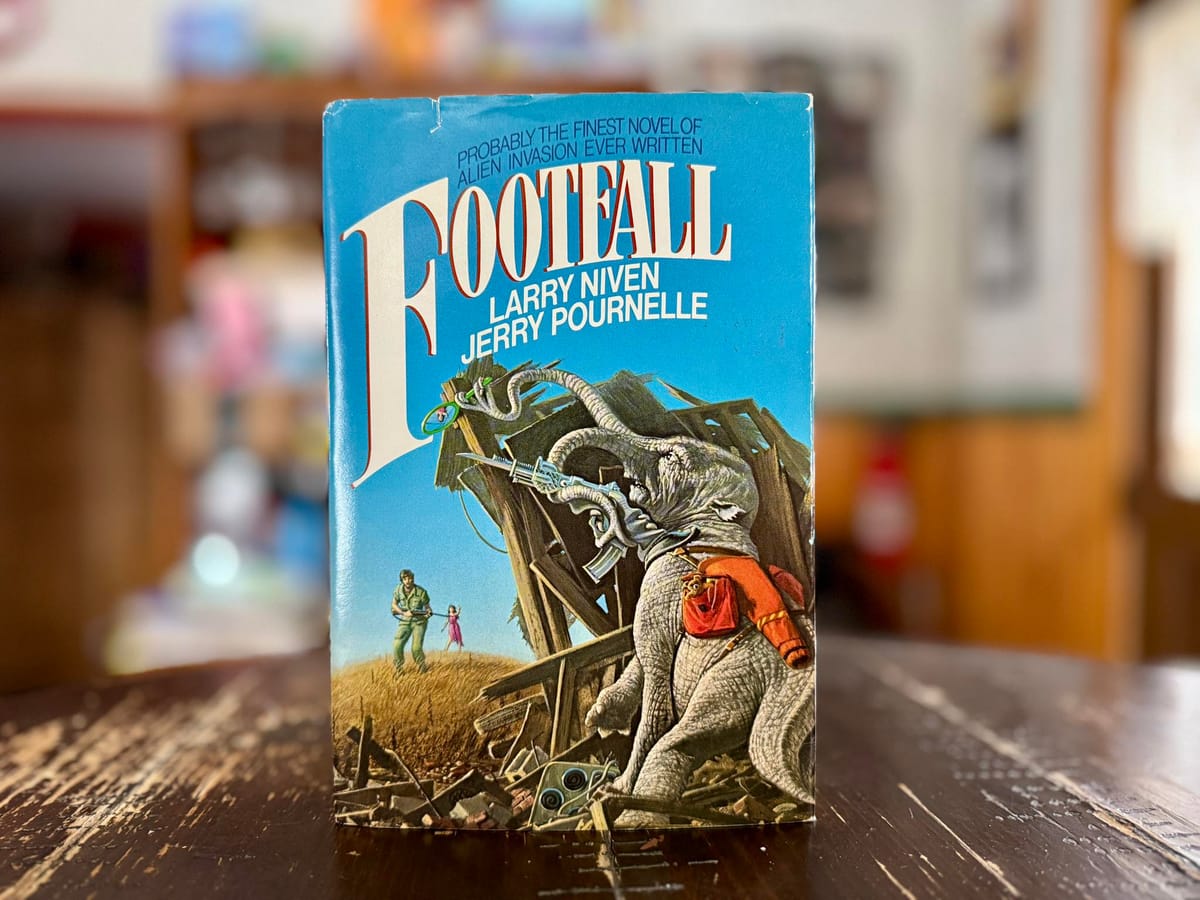
Throughout the ages, people have looked to the skies and wondered if we're alone, and after that brief, terrifying thought, what might happen if whoever's out there arrives on our doorstep. It's an idea that we've seen throughout the history of science fiction, from H.G. Wells' malevolent invaders in War of the Worlds or Cixin Liu's The Three-Body Problem to the uninterested in Arkady and Boris Strugatsky's Roadside Picnic and even to the more benevolent (ish) as in Arthur C. Clarke's Childhood's End.
These are stories that are often about our anxieties for our place in the world, and Footfall, the 1985 novel by Larry Niven and Jerry Pournelle serves as a useful time capsule of the fears that we'd accumulated throughout the decades of the Cold War.
The book kicks off in 1985, astronomers detect an object moving through the solar system from Saturn towards Earth, and quickly realize that it's not a natural comet or asteroid: it's an alien spacecraft. Our hails to it go unanswered, and the US dispatches congressman and space enthusiast Wes Dawson to a Soviet space station to greet them.
Upon its arrival, the alien ship launches an attack against the space station, capturing Dawson and the Soviet crew, and against the various militaries of the world, shooting down aircraft and missiles. It's a bloodbath, and they quickly gain control of space and the air, leaving humanity with few options to strike back.
The aliens are called the Fithp, who look a bit like baby elephants with several prehensile trunks. They've spent nearly a century traveling from their home near Alpha Centauri onboard their ship, the Thuktun Flishithy, to Earth. With a good chunk of their population going into stasis for the trip, they eventually arrive in our system and set up shop on an asteroid near Saturn that they call the "Foot," before turning their attention to Earth, hoping to turn it into their new home.
The aliens live in a herd-based society, and they had arisen from the ashes of a larger conflict on their own world, where a predecessor civilization developed a considerable amount of technology before wiping themselves out. Upon their arrival at Earth, they're bewildered by humanity and why they've attempted to greet them peacefully, rather than duke it out and figure out who is the superior "herd."
Over the rest of the book, humanity works to figure out how to counter the invasion. Their militaries severely degraded, the US and USSR launch a massive nuclear strike against the Fithp when they touch down in Kansas, wiping out their initial invasion, and astonishing the invaders at the extreme measure. From there, they double down on their efforts, redirecting the Foot and sending the asteroid crashing into the Indian Ocean, causing widespread devastation, before following up by landing ground forces in Africa, where they get bogged down when the humans begin using asymmetric tactics.
As they work to pacify the humans, the United States has formulated their own plan: launch a ship called the Michael, inspired by the Project Orion concept, in which a spacecraft is propelled by nuclear bombs. This ship would be launched into orbit quickly, where they'd use its onboard weapons and smaller fighter craft to attack the Thuktun Flishithy. A big, dramatic space battle ensues, and humanity ultimately prevails, forcing the Fithp to surrender.
The result is a book that's a bit self-indulgent (the science fiction writers are literally stand-ins for Niven, Pournelle, and Robert A. Heinlein, and the pair are more than willing to drop in a lecture about the values of self reliance or the pitfalls of the US welfare system), but scattering the story across a bunch of viewpoints is an approach that I like, especially when you're looking at big problems that the world is confronting, like an alien invasion.
By playing this story out across its huge cast of characters, from various members of the government, members of a doomsday prepper group who've set up an isolated community, reporters, science fiction writers, astronauts, and the Fithp, Niven and Pournelle get to really think through the complexity that an alien invasion might bring, nicely grounding the story and playing out a world that's contending with an ongoing disaster, while its characters are also figuring out how to make it to the next day.
 Andrew Liptak
But what really captured my attention is how this book is the product of a particular moment in US history, and how there's more than a small meta element to all of this.
Science fiction writers have long imagined what futuristic wars might look like: it's a tradition that you can trace all the way back to the late 1800s with British Army Colonel Sir George Tomkyns Chesney's novella The Battle of Dorking, and which you can follow throughout the 20th century through pulp science fiction to fictional scenarios from military officers all the way up to the modern day.
The future of warfare looked pretty damn science fictional by the time you reached the late 1970s and 1980s. The Cold War did something that prior conflicts couldn't: threaten humanity with the possibility of outright extinction with nuclear weapons. This was a battlefield that stretched from the jungles of Vietnam to the streets of Eastern Europe to beyond Earth's atmosphere and to the surface of the Moon. It involved new-fangled technologies like computers, which did everything from allocated resources and logistics to guide the missiles that could circle the Earth and deliver a nuclear bomb to a target on the other side.
In March 1983, President Ronald Reagan made an speech to the American public in which he announced the Strategic Defense Initiative, a weapons program that would utilize a range of new technologies, including lasers, particle beams and missiles, weaponizing space in an effort to overcome the strategy of mutually assured destruction that deterred both the US and USSR from launching ICBMs at one another.
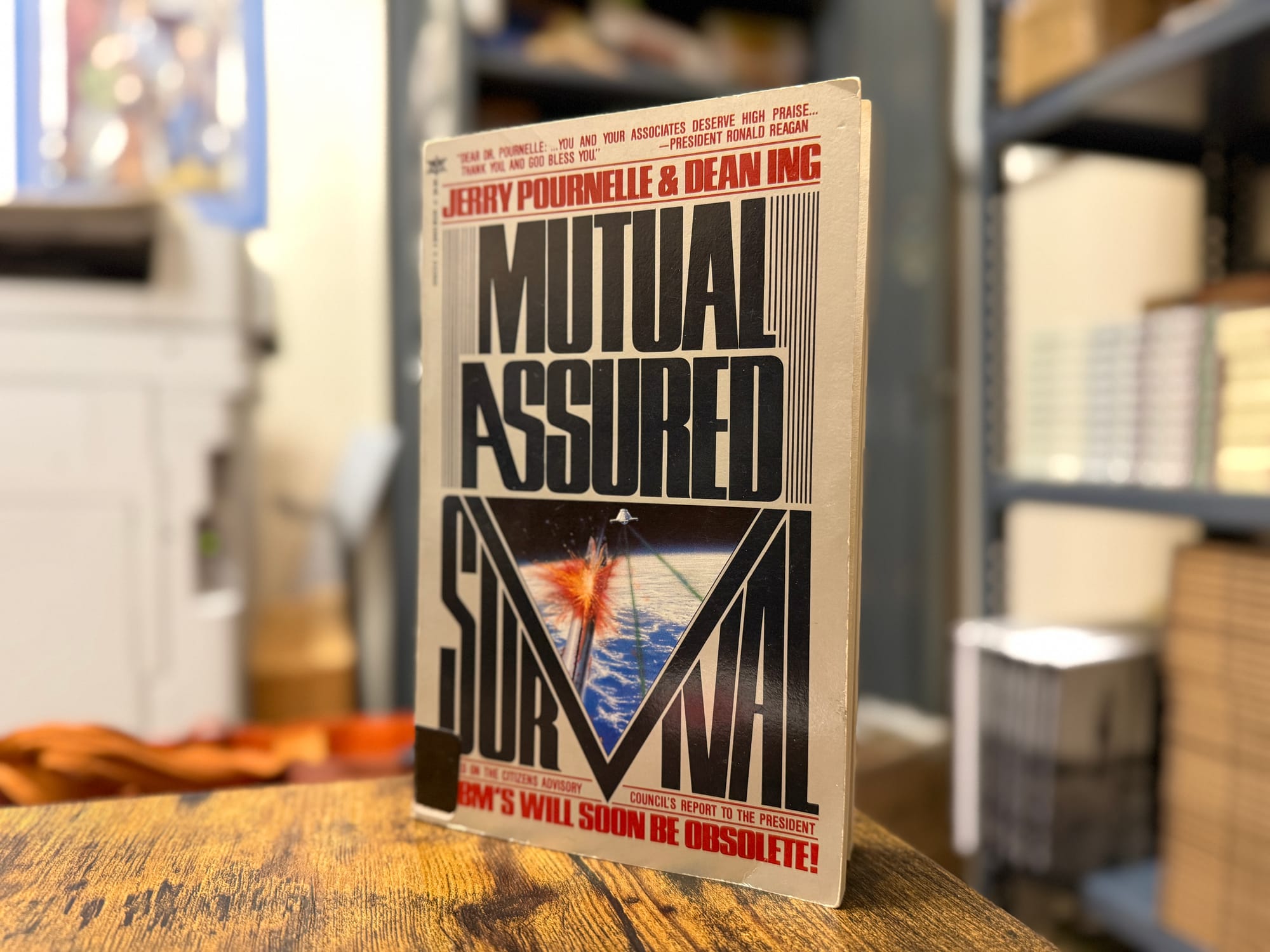
It was also a strategy that a group known as the Citizen's Advisory Council was advocating for. The group formed in 1980 following Reagan's election to assist the incoming administration's transition team with its science and space policies. In his book Reagan's War Stories: A Cold War Presidency, Benjamin Griffin noted that the group was "the brainchild of science-fiction writer Jerry Pournelle," who was already heavily connected to California's Republican party and now had a somewhat direct connection to the new White House.
Through his work and his science fiction, Pournelle had long explored the intersection of technology and warfare, and with Reagan's election, now had the opportunity to try and transform some of those ideas into reality.
"Strategic defense was the centerpiece of their agenda," Griffin writes, and the group was composed of not only science fiction editors and writers like Jim Baen, Greg Bear, Gregory Benford, Niven, Pournelle, Heinlein, and others, but also physicists, computer scientists, engineers, and even astronauts Buzz Aldrin, Fred Haise, and Phil Chapman.
The group met several times before Reagan entered office, and ultimately produced a "two-hundred page document covering a wide array of space-related issues the members hoped the Reagan administration would address," Griffin explains, with the writers taking "scientific jargon into language that 'made it far more interesting.'" The report landed on Reagan's desk who "reportedly read the entire document rather than just the executive summary," and it impressed him so much that his first National Security Advisor, Richard Allen, made it a point to consult with the group when it came to space policy.
The group was an influence in the conception of Reagan's rollout of the SDI, Griffin writes: "The speech's primary writer, Dana Rohrabacher, was in contact with the science-fiction community as he drafted it and was aware that 'a lot of creativity' was available to the administration on space issues," even borrowing language from their white paper. Later that summer, Pournelle and fellow author Dean Ing published a fictionalized version of their report, which they titled Mutual Assured Survival, which advocated for the initiative's various priorities and technological suggestions.
Shortly thereafter, Niven and Pournelle, who had collaborated 1977's Lucifer's Hammer and 1981's Oath of Fealty, teamed up again for Footfall in 1985, which bears the marks of their time with the Citizen's Advisory Council. The pair play out a scenario where space has been turned into a battlefield, and through the Fithp, they demonstrate the use of the sorts of advanced weapons the SDI could lead to, and that such a system could be used to protect the world from the threat that the Cold War arms race posed.
While Footfall was a bestseller, it and the SDI were controversial within science fiction fandom: the field had largely been divided by the experiences of the Vietnam War, and prominent authors like Isaac Asimov and Arthur C. Clarke advocated against the program, with the latter testifying before Congress against the probability that such a program would militarize space and advocated for more peaceful and cooperative solutions. His testimony prompted Heinlein to excoriate him at one of the CSC gatherings, which damaged their long friendship for years afterwards, and in which Clarke tearfully asked Greg Bear as he left, "do most American science fiction writers feel this way?"
This entire episode prompted editors David Hartwell and Kathryn Cramer to point out in their anthology The Hard SF Renaissance that US and UK fandom had reached a division, and that this was a consequence "of the overt right-wing politicization of American Hard SF that began in the 1970s." In his book The History of Science Fiction, Adam Roberts goes further, noting that Footfall and other similar books "reflected a widespread political shift, the dominance of Reagan's scorched-earth Republicanism in the USA and Thatcher's monetarist Conservatism in the UK."
Footfall is a full-throated advocation for a future where space becomes a battleground for Earthly affairs, and it's a good demonstration of how narrative can be a useful tool for conveying a complicated topic to a wider audience. In many ways, it's a gripping yarn that comes with plenty of action and excitement, while also delivering the group's leanings to the wider public: an advanced network of spaceborne weapons could nullify the long-established policy of armed deterrence.
I'd like to think that their goals were well-intentioned: the mutually assured destruction doctrine carries with it plenty of dramatic scenarios that will lead to our extinction in a matter of minutes. But it's also the continuation of a mindset that only serves to escalate the tensions between global superpowers, and a rejection of the policies and agreements that would rein in the use of these destructive weapons.
Published nearly four decades ago, the tensions between the United States and Soviet Union Footfall depicts might feel like ancient history, given that the former began to disintegrate in December 1991, and Reagan's SDI program ultimately never did anything but cost taxpayer dollars.
But the threat of the apocalyptic destruction nuclear war could bring has never gone away. While the US and USSR signed on to international treaties that curtailed the use of ICBMs, the ongoing conflict between Russia and Ukraine and the growing tensions between the nine countries who possess nuclear weapons serves as a stark reminder that the factors that resulted in the formation of the Citizen's Advisory Council and the SDI are still simmering. Footfall, for all that it brings out a brash, cinematic blockbuster of an alien invasion, feels less like a cautionary tale than it does remind us that we haven't really left that era in the past.