Neverending stories
Thomas Elrod on his debut novel The Franchise, franchise stagnation, and finding creativity in a world of slop
If there's something of a central mission to this newsletter, it's my way of examining and exploring the various ways we tell stories. Sometimes, that's through a roundup of the latest books, how the military sometimes uses science fiction as a tool, the power of oral histories, or how you sometimes find a gem of a story in an established franchise.
As such, I'm endlessly fascinated by stories that grapple with the idea of storytelling and incorporate in an interesting, meta way. John Scalzi's Redshirts explores what happens when its characters realize they're trapped in a crappy TV show, Carrie Vaughn's Questland imagines a fantasy theme park taken to its extremes, while in Hazelight's Split Fiction follows a pair of authors who are dropped into their own stories during a technology demonstration. When done right, it's an interesting way to explore the ways we create stories, and sometimes, comment on the larger contexts that have birthed them.
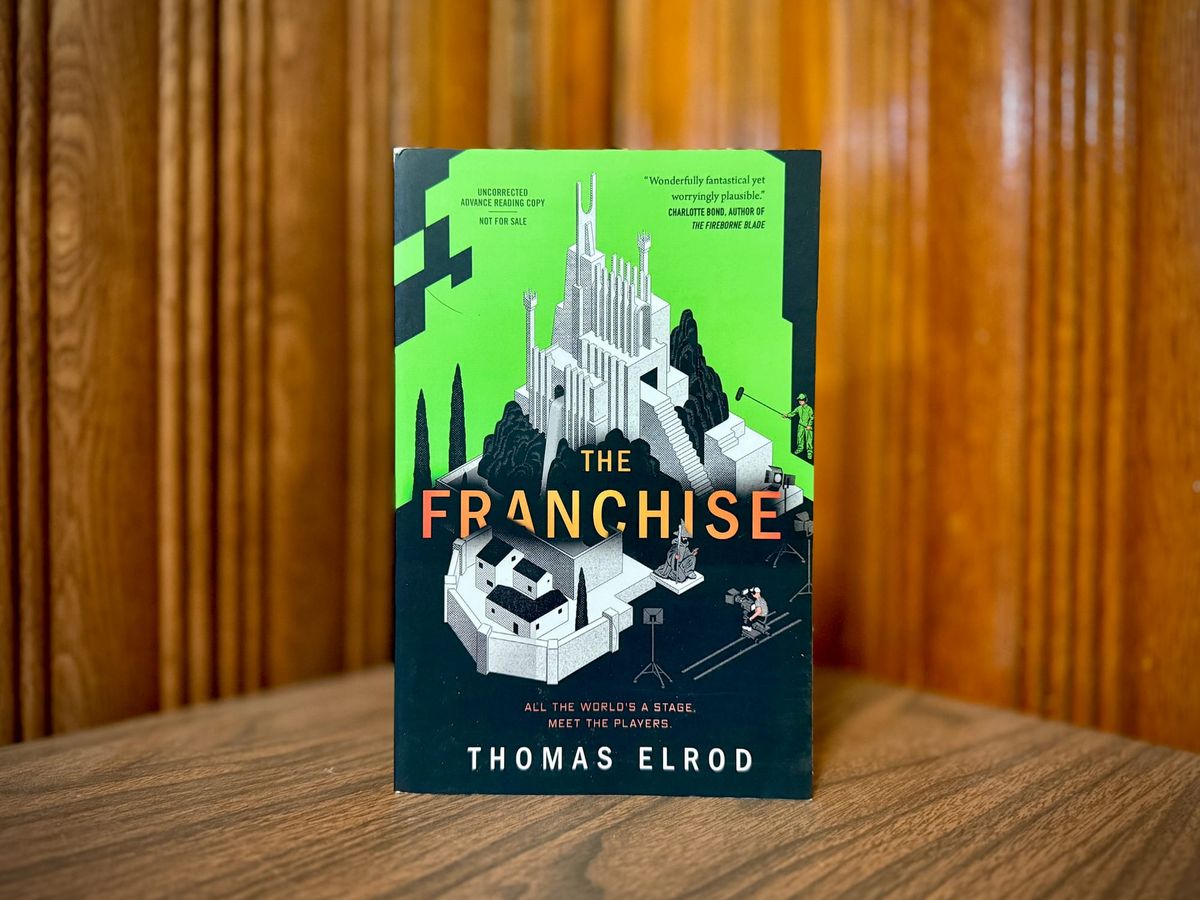
That's why I've been excited to check out Thomas Elrod's debut novel, The Franchise. It's about a media franchise that emerged out of an epic fantasy novel published in the 1960s, The Malicarn. It goes on to become a major hit and spawns a media franchise that includes films and additional novels. Its corporate owners aren't content with those successes, and launch a new initiative: they've built the world and utilize some new technologies to mess with the memories of the actors embedded there so that they believe that the fantasy world is real and that they're part of it. Things go astray from there.
It's a fascinating read, and got to chat with Elrod about the novel and the themes it's exploring. We did just that: talking about creativity, the nature of endless franchises, and a bit too much about the state of the Star Wars franchise.
This interview has been edited for clarity and length.
To start off, can you tell me just a bit about yourself?
I've been writing all my life, but I haven't published a lot of fiction, [just] some criticism and stuff. But I’ve worked in publishing in various capacities, mostly academic publishing. This is my first novel, and I've been working on it for a couple years now and I’m excited for it to finally come out.
What work do you do in the publishing industry?
I currently work for an academic publisher, where I acquire math books.
What got you started in that field?
My background academically is not math or sciences at all, actually. I used to work managing math journals, in very much a project management kind of role, and so I just was in the math research space there for a while, and am still and learning a lot about how mathematicians think and work and approach things.
So when you went to go publish a speculative fiction novel, how different did you find the world of commercial fiction as opposed to mathematics books?
Well, I mean, it's different because the audiences are obviously much different. You're working with academic communities that are focused on the research and the output and what's coming out of it. They’ll do books and stuff, but they just have different goals for what the purpose of the book is and what the expectations are of it are, whereas, commercial publishing is much broader—
A little more a little more chaotic?
— a little more chaotic. Longer timelines, really. In academic publishing, you're always pushing to get the research out as fast as you can because you want it [to be] accessible to people. Fiction publishing especially operates on a much longer time scale.
It’s a very diverse industry and I think people don't always see that if you're on the outside of it.
Can a you tell me a little bit about how you got interested in science fiction and fantasy? Do you prefer one over the other?
I don't think I have a strong preference. I've been reading and watching both my entire life and that's always been a big interest of mine. I read broadly and don't only read science fiction and fantasy, but in my writing, it's those genres that I've been the most interested in. I grew up watching Star Trek or reading classic golden age science fiction, like Isaac Asimov and things like that, and as I grew up, it just continued to always be kind of my genre of 1st choice
I think that's just because they have so much room to explore ideas and themes and that you can kind of do anything, but they can also be literary. They can also be fun.
Were there any authors that you gravitated to or still hold some nostalgia for?
I mean, as I've gotten older, a lot of science fiction writers, New Age science fiction writers from the 60s and 70s, whether it's [Ursula K.] Le Guin or Philip K. Dick, [Samuel R.] Delaney, or Gene Wolfe, there's that group of writers who are still exploring and who're still finding interesting combinations of classic science fictional ideas and concepts with real literary chops. It's something that I aspire to myself, and so they've been very important.
In terms of nostalgia, I was really into [J.R.R.] Tolkien as a kid and I still appreciate [him] lot, but like, I wouldn't say I go back and reread Asimov or something. It doesn't do it for me in the same way anymore. It was very important at a very certain time of my life, but I can see the limitations of some of that now, but I think that the stuff that still works from those early science fiction writers – I read a lot of H.G. Wells and that kind of stuff as a kid and that still is very interesting.
So I think – I try to be careful with nostalgia. This gets into the book a bit, but something that maybe was really important when I was 10 is important for all the various reasons I could list, but I try not to make any one author or property or kind of writing or anything too central to what I want to do going forward. I don't want to feel like I'm trapped within the confines of what I liked when I was a child and maybe sometimes investigate why the things that spoke to me at a certain age, continue or not continue to be important. But you can also let them go at a certain point if you need to, or acknowledge what they can't do at a certain point.
Yeah, they say that the age of science fiction is 12.
Yeah.
One of the things that I've been fascinated by is that we're living at a time when speculative fiction properties have been really growing in prominence and importance to popular culture, and it's interesting to see what authors and stories were established in the 50s/60s/70s and how some are still resonating with audiences today. With that in mind, can you tell me a bit about how this book came about? How did you conceive of the story?
It ended up being a book that's very told very nonlinearly, but I didn't approach it that way initially.
It really started with just feeling – I think we all feel – how is some of these intellectual properties that are producing content continuously – what's the endgame with them? I mean there's always been sequels and series and stuff. It used to be that you make 7 or 8 sequels to Police Academy or something, but eventually you stop making those movies because they stop making money.
But it feels like there's no way that Disney is going to stop making Marvel movies, even if they continue to be not very good. They have to continue making Star Wars movies. Their business is too tied to that, right? They have to continue doing it. There's not a way that it ends organically. You can't stop making these movies, and I think we're all kind of exhausted by it.
So it started with that idea and then take it to a ridiculous extreme, which is, that the studio creates a world of its own that perpetuates itself forever, kind of like The Truman Show, where it's all being filmed and the people in it don't know it. It's just more endless content.
And so then it becomes a thought experiment and a story and all these other things that you can do in a novel, but yeah, just really starting with the idea that the story can't end; not because the author dies or because they're done writing it, or they just can't sell it anymore, but it can't end because economically it's never feasible for it to end – what happens to storytelling after that?
I've found Dune to be one a fascinating property. After Frank Herbert kicked off the series in the 1960s, he continued it because his publishers were willing to throw gobs of money at him, and then his son continued to publish installment after installment to continue it.
It's not so much creative continuation but pressure from fandom or readers and audience members that are making the demand for these products. What is it about people that wants to continue to immerse themselves in these worlds – and I say this as someone who's a big Star Wars fan.
It's tough. I think there is a innate, probably very old need from people to revisit the stories that they like and feel immersed in them. It goes back a long way and has probably always been there to some extent. And people, you know, kids love to hear the same story over and over again. I think adults do too. I think it's just that there's something about the way stories work and how we respond to them. I don't know if it's some innate psychological thing, but that is part of it, and I think that that can be encouraged in productive or non-productive ways. That's not new.
Sure, look at Shakespeare or the Odyssey.
Yeah, people return to things over and over again, or even people's relationship to stories and how they really identify with them. There are famous stories of people waiting on the docks in New York for latest Charles Dickens story to come in because they want to know what happens to, those characters. This is not a new thing, and I think that it can be used well if stories are being used to generate community and help people process the world and all of these things and you can, you can return to the same story over and over again in different ways to do things with it.
I think that there are obviously ways that turns sour. We see that in all sorts of ways, whether it's online fandoms that are very hostile, the way that then it can be monopolized and turned into just content and product that does tap into fans' energies and passions and whatnot, but can use that passion as an engine for revenue and not actually trying to do something interesting necessarily with that passion.
'Content' is such a horrible word, isn't it?
It is. Right? Ew. It doesn't sound good, and it's everything from AI slop to emails that you get from Old Navy to books and movies and because it encompasses anything, it really means nothing and it sounds gross.
I'm a big Star Wars fan – I grew up with the Special Editions and Prequels, and I've found Disney's acquisition of it has been fascinating because they're bringing in people who're very talented and passionate creators for this world, but also because of the amount of stuff they've put out has been so varied. You have everything from Rise of Skywalker, which was –
Bad.
Yeah, it wasn't great. But then you have things like Andor, which is at the other end of the spectrum.
I think those two examples are good because the reason – obviously, Rise of Skywalker wasn't the first bad Star Wars movie, right? I'm not really of the generation that has this reappreciation for the prequels, but say what you will about them, they are the movies George Lucas wanted to make, and he made them according to his creative vision.
I think the thing with The Rise of Skywalker is that it's just feels so cynical. It feels just –
It feels very constructed.
Yeah, it feels so constructed and that it has a lot of notes from corporate. And you know, it was made very quickly and they rewrite it all, and the stuff that happened to it. It just – you can say things don't work in a movie and that's fine, but it's different when it just feels like it isn't even an exercise in trying to tell a story that didn't work. It's just like, whatever.
Whereas Andor, we have a vision for how to – we have something we want to say and something we want to do with this property.
It doesn't exist just to exist.
It does not exist just to exist. It's also not about itself, which is another thing – and it's not just a Star Wars problem. I think this is what's going happening the Marvel cinematic universe and other things right now is that at a certain point the movies that are coming out are just about the franchise. And that's maybe a little bit fun. But if you're not a hardcore fan, it gets less fun. Rise of Skywalker doesn't really have anything to say about anything other than Star Wars or Easter eggs.
Whereas Andor is in the world, but it's saying something about something else. I think that's the thing – when a story is just about its own existence, it loses something.
Yeah, you have to be good about using that type of storytelling.
I mean, it can be. The Force Awakens is also a movie about Star Wars and it has its flaws, but it was very entertaining. I had a great time when it came out. I think you can criticize various things about it, but it's not cynical in the same way. They did what they wanted to do with it. We're not going to stop with revisiting stories and building out story worlds and all of this stuff – I think those are things people like to do. And they like to do that for everything from not just science fiction properties, but you know, fandoms of sitcoms and fandoms of all sorts of things. That's gonna continue to happen. It's just – are we just going to be stuck with these large, cynical versions of them as opposed to something else?
And I don't mean to talk all about Star Wars for this. It's just a very handy horse to beat.
I think it's a good [example] because everyone knows it and everyone sort of understands.
I'm going to get back to your book in a second, but I'm curious how you look back on the last couple of decades, given that nerd culture has been so ascendant with things like Harry Potter and Lord of the Rings and Game of Thrones and all those big franchises? How do you see that rise of cultural acceptance?
Yeah, I mean, it's a double edged sword, right? On the other hand, it's exciting that you could give a director like Denis Villeneuve the option to to make these big-budget Dune movies that takes them seriously and people go to see them and that's cool.
On the other hand, you get a culture of fandom that isn't healthy – not specifically about Dune, nerd / gaming culture – where we've seen it weaponized through things like GamerGate that are that kind of hostile, misogynistic side of things, weaponized in the culture in a way that's not good. There are definitely people in the government at the moment that seem like they came up in this kind of internet sludge and that's not good.
I don't want to necessarily equate these two things, but I think there's a lot of complicated reasons for how the internet plays a big role in just making things more accessible to people. That's largely good, in the sense that people can find communities and things that they otherwise wouldn't have found. It was very difficult at one point if you wanted to listen to a certain band that hasn't broken through yet to find their album and now it's much easier to do that. But the trade-off is then also that it's very easy to get encased in cult – in fan communities that maybe aren't super healthy for a variety of rhetorical reasons,
But in terms of being in a culture where science fiction and fantasy movies and books are largely accepted and people don't instantly scoff at them – I think that's good. I don't think that means that other genres should be hurting from that, but it's fun to see, and I just hope that we have a more healthy critical community around these things.
So with all of that in mind, I want to come back to The Franchise: how did this environment shape this story – or is my is my assumption correct that it fed into it?
Yeah. I was thinking a lot about the kind of cultural milieu that we exist in and like I said, how these things develop and at what point is it going to change to something different? Because it doesn't feel like it changes as much, we're stuck with the same sorts of things that remain popular for a very long time and it's very difficult for other things to break through.
The fact that I guess Patrick Stewart and Ian McKellen are in the next Avengers film this fall – great? I guess I like to see them and that they're getting paid, but those first X-Men movies came out 26 years ago, and we're just going to continue to feed on that until they're no longer with us.
There are corporate, capitalist reasons for these things being produced a certain way, and but there's also an inability to aerate or make anything new – just what happens to the culture you do have? I think we're seeing a lot of that, and the book is thinking through that in a very science fictional conceit – that they have set up this island full of people who's memories have been changed to think that they're part of the show, and they live out their lives thinking they're a part of it. They can't change or escape from that because the story can't change, so they're stuck in this world.
That's what's behind this whole thing. What interested me is that at some point, something has to change, but not everyone wants that to happen. So what do you do when you discover that what you thought was the world isn't really the world and you don't want it to change (and vice versa). For the people making this stuff, how do they feel about that, is it really what they want to be doing as artists? What excuses are they making for themselves?
Something I've long been frustrated by in the SF/F world is that we have this imaginative genre, only for people to be completely unimaginative in trying to find new things. I guess it's a tendency we have.
Yeah, it's a tendency, but it's really exacerbated by how things are produced and distributed. I don't know how it ends, honestly.
Hah, I was about to ask if have any thoughts on how to fix that.
I will say this, and it has to do with AI. There's a lot of doom and gloom about AI, but I think if there's a silver lining, it's that people – at least in my experience – don't seem to have much appetite for AI art as some sort of replacement for human art. There are people here or there who seem to think this, but for the most part, if you see a photo or a video of a funny dog doing something and you find out it's AI, the response is like "oh. That's not funny now. That was a funny dog, and now it's not funny anymore."
With art, I just don't get the impression that people want that. They're going continue to cram it down our throats, but if there's something that comes out of this era, it'll be an appreciation for the humans who make incredible things and we should support that impulse and we should seek out people who are using their talent and creativity to do new things. I think that might be an impulse that grows stronger as time goes on and maybe lead to interesting new things, because if there's something we can do it's something people have done before and that's not fun. I don't think anyone wants to live in a world that's like that forever and always. Maybe that'll spur something. I try and remain hopeful about that.
What do you hope that readers will take away from this type of narrative?
I hope they have fun with it. The way the story is told is it jumps through time and through multiple points of view and some people – there's a lot of dramatic irony built in and I hope people enjoy that.
In terms of coming away with something, I hope they think about our own world and how we can move forward – there's a larger thing here beyond science fiction and fantasy properties – it feels like we're very stuck in a certain way of being as a society that isn't very healthy. Is it possible to build something different out of that? I don't know what the answer is to that, but I do hope it's a question people ask.
The Franchise is now available in bookstores.