Destination: The Asteroid Belt
Flying piles of rubble
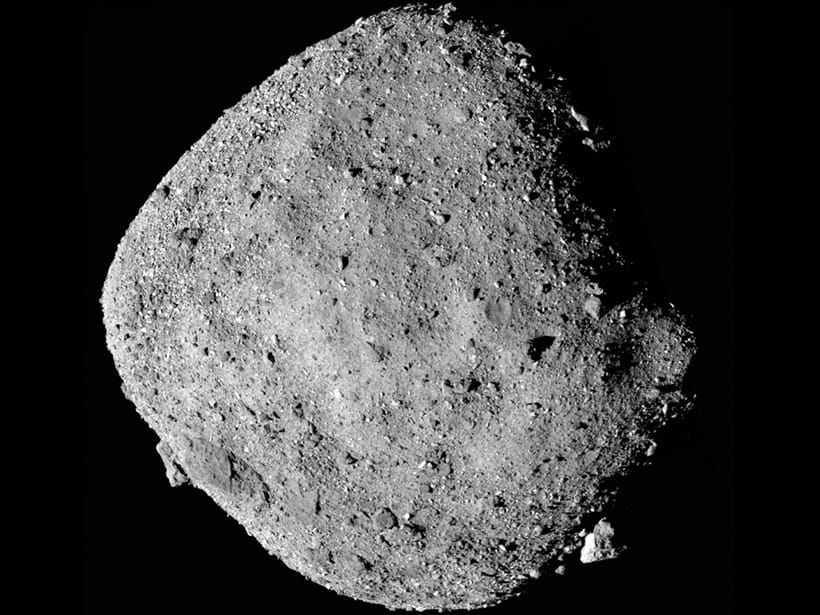
“You're not actually going into an asteroid field?”
In 1980’s Star Wars: The Empire Strikes Back, Han Solo, Leia Organa, Chewbacca, C-3P0, and R2-D2, are fleeing from the Galactic Empire’s forces aboard the Millennium Falcon, when they encounter a new problem: the Hoth system’s asteroid belt. Desperate, Han orders Chewie to a new heading, straight into the field. “They’d be crazy to follow, wouldn’t they?”
The maneuver works: their immediate pursuers are destroyed when they collide with the flying rocks, giving the crew a needed respite to fix their ship and continue their escape.
The asteroid scene is memorable and exciting. Pursued by Star Destroyers and TIE Fighters, the Millennium Falcon zips past the tumbling asteroids, narrowly escaping danger as the gaps narrow. But like most science fiction films, it’s a scene that bears little resemblance to the nature of the real asteroid belt that orbits the sun between Mars and Jupiter. But while George Lucas’s asteroids make for an exciting chase scene, our asteroids have an exciting story of their own, one that tells us much about the formation of our solar system.
The star and planets that make up our home system formed from a nebula of gas around 4.6 billion years ago, with the sun hoovering up most of the region’s matter, and much of the rest forming the planets. The solar system’s early years were chaotic: the intense gravitational pull of the gas giants pushed around what matter remained in the solar system, and some of what remained began to coalesce and settle between the planets as much smaller objects: asteroids.
While humans recognized that the planets were celestial objects that were different from stars, asteroids were too small to be directly observed, and their discovery came much later in human history. It was the development of the field of physics and planetary motion, as well as the creation of the optical telescope, which helped pave the way for their discovery.
In 1766, German astronomer Johann Daniel Titus realized that the planets were spaced proportionally to one another and hypothesized that there could be a body orbiting the sun in the gap between Mars and Jupiter, as well as other bodies beyond Saturn (then the furthest known planet.) In 1781, German-British astronomer William Herschel discovered the solar system’s eighth planet, Uranus. Its location lined up with where Titus’s formula predicted a planet would be, prompting other European astronomers to begin looking for additional, previously-undiscovered planets.
One of those astronomers was Baron Franz Xaver von Zach of Germany, who in 1798 began a systematic search for the planet that should be floating between Mars and Jupiter. He contacted twenty-four fellow astronomers, and dubbing themselves the “Celestial Police,” began to study sections of the night sky for signs of a new object.
Despite their efforts, it was another astronomer who ended up spotting that object. On the night of January 2nd, 1801, Giuseppe Piazzi of Italy spotted a bright light through his own telescope. “The light was a little faint, and of the colour of Jupiter,” he wrote, “but similar to many others which generally are reckoned of the eighth magnitude.” He went out on the nights that followed, and found that it couldn’t be a star. He initially thought it could be a comet, but after further observations, realized it was moving like a planet.
Other astronomers would confirm Piazzi’s discovery: he had found a body, but one that was much smaller than the planets of the solar system. A year later, a member of the Celestial Police, Heinrich Wilhelm Matthias Olbers of Germany sighted another, similar object in the same region of space, which he named Pallas. Like Ceres, it was also extremely small, and after some disagreement, Bode suggested to the Royal Astronomical Society that they call the objects “asteroids,” derived from the Greek word “asteroeidēs” (starlike).
They had discovered an entirely new type of body orbiting the solar system, ones that were not only much smaller than the planets, but greater in number. Quickly, astronomers spotted two additional asteroids: Juno in 1804 and Vesta in 1807. The scientific community was torn over how to describe these objects, and broadly, astronomers referred to these new bodies simply as planets. The next discovery came in 1845 when Karl Ludwig Hencke spotted Astraea, kicking off a new era of discovery for astronomers. In Is Pluto A Planet: A Historical Journey Through the Solar System, David A. Weintraub notes that “with more powerful telescopes and better star charts then available, three more asteroids were discovered [in 1847], followed by one discovery in each of the next two years, making a total of six asteroids discovered in the 1840s. Subsequent decades saw 47 discovered in the 1850s, 52 in the 1860s, 102 in the 1870s, 76 in the 1880s, and 165 in the 1890s.”
The discovery of this new class of objects and realization of an increasingly crowded solar system came at the same time artists and writers were planting the seeds that would eventually form science fiction. Writing in the second edition of The History of Science Fiction, Adam Roberts notes that by the early 19th century, “we can see a number of broad fascinations working their way through the SF writing: an increased interest in the mystical and theological component of interplanetary or interstellar romances [and] reflections in an imaginative literary form of 19th-century advances in science, technology, and industry.”
With the discovery that multiple bodies orbited between Mars and Jupiter, astronomers began to find explanations for the nature of their existence: Olbers advanced a theory that the asteroids that he and his companions had discovered were once a single planet, but which had been destroyed by the gravitational pull from its neighbors, while others pointed out that the collective mass of the known asteroids would amount to an object much smaller than the planets.
Science fiction authors jumped on the former idea: a titanic disaster had destroyed the former planet and left its fragments scattered across space. In his 1895 novel The Crack of Doom, Robert Cromie plays out a story that involves the first depiction of a nuclear explosion, which one character attributes to the destruction of the former fifth planet.:
"The agent I will employ has cost me all life to discover. It will release the vast stores of etheric energy locked up in the huge atomic warehouse of this planet… Once before, in the history of our system, an effort similar to mine was made, unhappily without success. This time we shall not fail!"
A low murmur rose from the audience as the lecturer concluded, and a hushed whisper asked: "Where was that other effort made?"
Brande faced round momentarily, and said quietly but distinctly:
"On the planet which was where the Asteroids are now."
This supposed, dramatic event in the solar system was ripe fodder for the authors writing science fiction in the early 20th century: a small planet destroyed by some sort of cataclysm. In an entry on asteroids in Science Fact and Science Fiction: An Encyclopedia, Brian M. Stableford writes that “asteroids’ status as ruins of a Bode-sequence world was often confirmed in pulp science fiction,” and that they “were also used in that medium as ‘desert islands’ where castaways might wash up or be deliberately marooned.” One notable example comes from author Isaac Asimov, in his 1939 debut story, “Marooned off Vesta,” in which the crew of a damaged spacecraft end up in Vesta’s orbit:
“‘Funny place, Vesta," observed Mike Shea. ‘I was down there two-three times. What a dump! It's all covered with some stuff like snow, only it ain't snow. I forget what they call it.’
‘Frozen carbon dioxide?" prompted Moore. "Yeah, dry ice, that carbon stuff, that's it. They say that's what makes Vesta so shiny.’”
Alfred Bester’s 1956 novel The Stars My Destination, depicts a similar scene, as crewman Gully Foyle finds himself wrecked and taken in on an island-like refuge:
“Between Mars and Jupiter is spread the broad belt of the asteroids. Of the thousands, known and unknown, most unique to the Freak Century was the Sargasso Asteroid, a tiny planet manufactured of natural rock and wreckage salvaged by its inhabitants in the course of two hundred years.”
Asteroids also proved to be a useful setting for another type of story: that of the discovery of untold riches. Authors have often drawn inspiration for their stories from the history of real world exploration, substituting the long travel across Earth’s oceans for that of our solar system and interstellar space: travelers encountering faraway lands and peoples, hoping to encounter and extract new riches. Stableford draws a comparison of asteroids to the gold rushes of North America, in which “the representation of asteroids as a Klondykesque frontier where hard-working prospectors are harassed by all manner of outlaws as in Clifford D. Simak’s ‘The Asteroid of Gold’ (1932), Stanton Coblentz’s ‘The Golden Asteroid’ (1935),” and plenty of others."
The notion of asteroid mining goes back to the late 19th century, in Garrett P. Serviss’s 1898 novel Edison’s Conquest of Mars, which found Earth’s adversaries mining the solar system for gold.
“For a moment we were startled beyond expression. The truth had flashed upon us. This must be a golden planet—this little asteroid. If it were not composed internally of gold it could never have made me weigh three times more than I ought to weigh.”
“For a moment we were startled beyond expression. The truth had flashed upon us. This must be a golden planet—this little asteroid. If it were not composed internally of gold it could never have made me weigh three times more than I ought to weigh.”
The notion of mining asteroids would jump from fictional to theoretical as the US-USSR Space Race took off in the 1950s and 1960s, with NASA scientists posing the idea that once we’d visited the Moon and Mars, asteroids could be another destination, especially if they were home to valuable metals. In his 1977 book, The High Frontier: Human Colonies in Space, Gerald K. O’Neill pointed out that because it is relatively poor in hydrogen, oxygen, and carbon, the Moon might not be a great candidate for mining operations. But, he notes, asteroids are abundant in usable elements. “Long before an appreciable fraction of the lunar surface has been mined,” he wrote, “it will become easiest to obtain all the materials for colony construction at the asteroids themselves.”
Furthermore, he points out that mining operations could likely reach more of an asteroid’s total wealth: “we would have to disfigure the entire Earth to obtain only a hundredth of the material contained in now-useless, lifeless asteroids; and there are thousands of those minor planets.”
Science fiction authors followed suit, in books and stories such as Donald Kingsbury’s 1978 story ‘To Bring In The Steel,” which imagined astronauts harnessing asteroids and bringing them closer to Earth’s orbit, to C.J. Cherryh’s 1991 novel Heavy Time, to more modern takes, such as James S.A. Corey’s The Expanse series–which depicts humanity mining the asteroids for not only metals, but water to support a myriad of habitats and the terraforming of Mars–to Daniel Suarez’s Delta V, which depicts tech billionaire standing up a covert mining mission to an asteroid.
 Andrew Liptak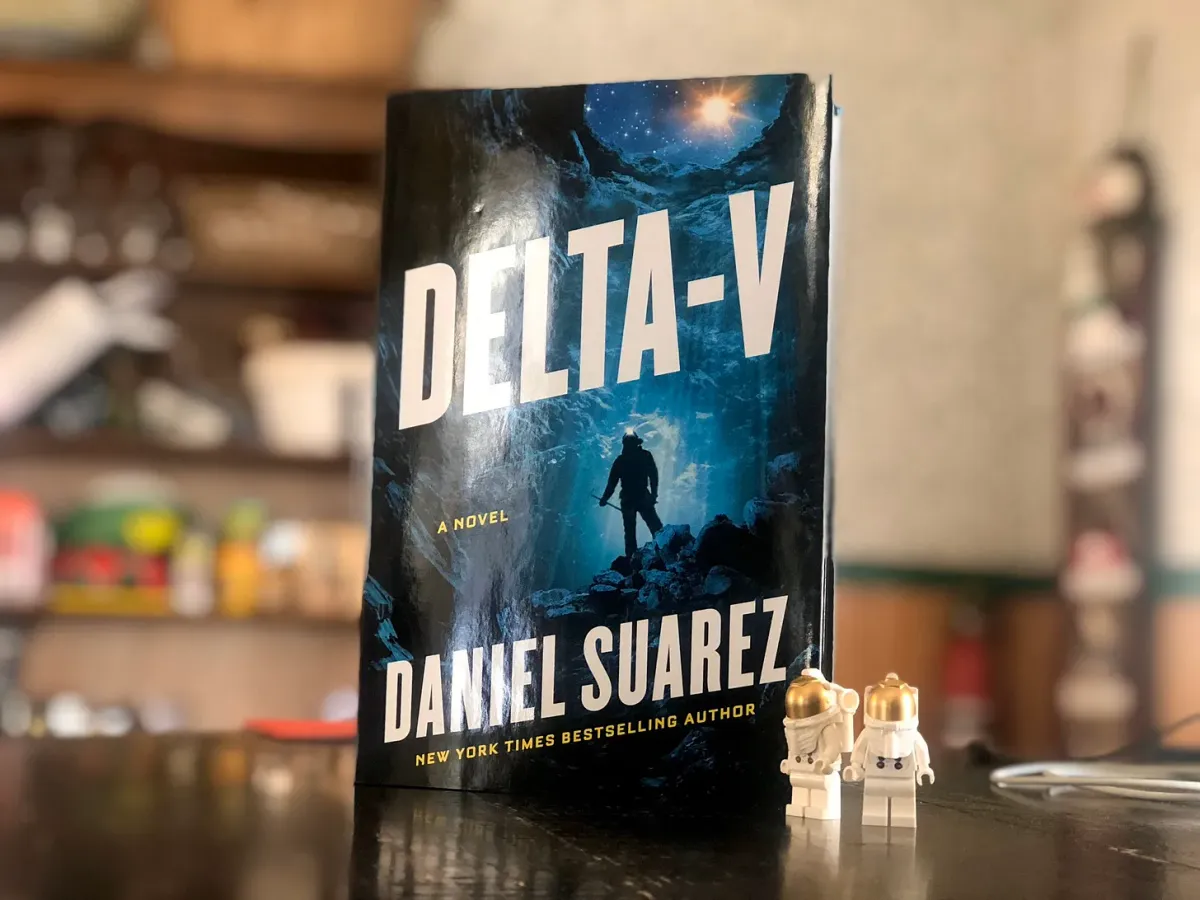
As the space race progressed and and as astronauts spent more time in space, theorists and scientists such as O’Neill speculated that we’d need to find new ways to live in space, ranging from habitats such as Skylab in 1973 to more theoretical structures like cylindrical or spoke-shaped stations that could rotate and simulate gravity. O’Neill noted in his book an inhabited asteroid belt in the long run becomes more economical, given the resources required to reach it from Earth.
This too is something that genre authors had prefigured, as in Bester’s novel: “he was being carried in triumph on a litter through the natural and artificial passages within the scavenger asteroid. They were constructed of meteor metal, stone, and hull plates… the passages led to great halls, storerooms, apartments, and homes, all built of salvaged ships cemented into the asteroid.”
Other depictions were more sophisticated, such as in Greg Bear’s 1985 novel Eon, in which an asteroid appears in Earth’s orbit, hollowed out to enclose a massive habitat. “It could have been Los Angeles on a very clear day, or any other modern terrestrial city, except for the surreal exaggeration. It was bigger, more ambitious and ordered, more architecturally mature.”
Other novelists, such as Kim Stanley Robinson in his 2012 novel 2312, feature lavish descriptions of asteroid habitats, while James S.A. Corey’s Leviathan Wakes imagines an entire network of habitable asteroids in the belt, with major population centers located on Ceres and Eros.
After Apollo 11’s successful landing on the lunar surface in July 1969, the American public’s appetite for further missions waned and NASA began to shift its priorities from crewed missions to robotic ones. In the 1960s, the space agency began work on an ambitious program to study the solar system’s outer planets, the “Grand Tour” which was eventually cancelled and replaced with other probes. The first were Pioneers 10 and 11, with a stated mission to study Jupiter and Saturn. They first had to pass through the asteroid belt in 1972 and 1974, and were specifically designed to make observations of some of the asteroids they encountered.
It wouldn’t be until 1989 that NASA got an opportunity to take a look at an asteroid up close: it launched the Galileo space probe on October 18th 1989. The probe was headed to Jupiter, but while passing through the asteroid belt, astronomers took the opportunity to take a look at two of the belt’s inhabitants: 951 Gaspra in 1991, and 243 Ida in 1993. The probe took a number of detailed images of both asteroids’ surfaces before moving on. It was followed three years later by another probe on February 17th 1996: the Near Earth Asteroid Rendezvous–Shoemaker (NEAR Shoemaker) probe, the first specifically designed to study an asteroid: 433 Eros.
Like Galileo, it took images of an asteroid while enroute, 253 Mathilde, taking nearly 500 images (nearly 60%) of the asteroid’s surface from a range of 1200 kilometers, before reaching Eros in February 2000. There, it settled into its orbit and after nearly a year, mission controllers deorbited the satellite and eventually touched down on the surface on February 12th, 2001.
Scientific interest in the asteroids has increased in recent years: realizing that asteroids provide a unique insight into the solar system’s earliest days, astronomers have begun closely examining their composition, not for the purposes of mining, but for attempting to locate complex molecules that might have delivered the life’s building blocks to Earth billions of years ago. In the last two decades, various space agencies have dispatched a number of additional probes to various asteroids: Hayabusa in 2010, which delivered samples back to Earth, as well as the Dawn spacecraft, which reached 4 Vesta and Ceres in 2011 and 2015, respectively.
 Andrew Liptak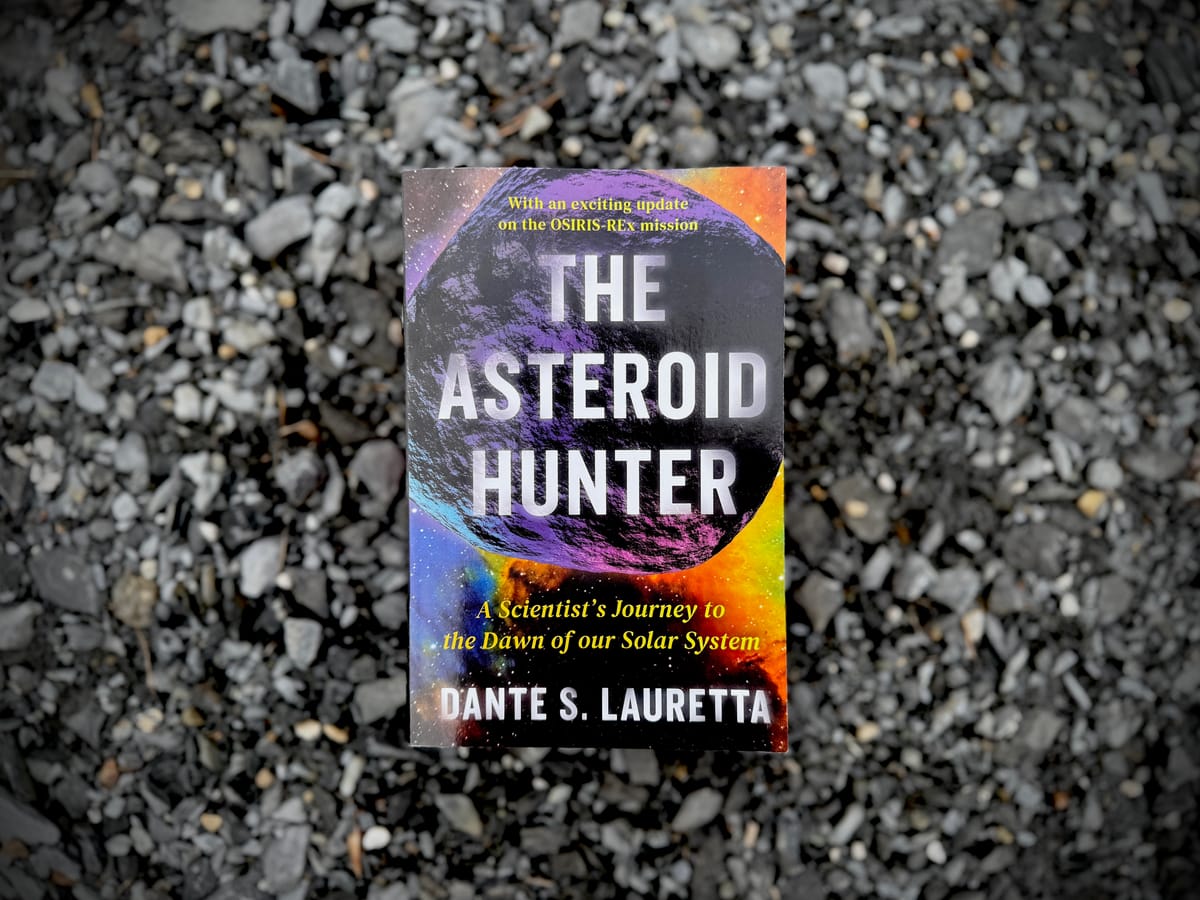
Hayabusa2 arrived at 162173 Ryugu 2018 and returned samples to Earth in 2020, while NASA launched the OSIRIS-REX mission to 101955 Bennu in 2016, with samples coming back to Earth in 2023. Both Hayabusa2 and OSIRIS-REX have had their missions extended and are headed to their new targets, 1998 KY26 and 99942 Apophis, where they’ll arrive in the coming years. Undoubtedly, their discoveries will find their way into science fiction stories yet to come.
Asteroids have shown up in science fiction in one other major way: when they impact the planet.
Arthur C. Clarke open his 1973 novel Rendezvous with Rama with a dramatic scene on September 11th, 2077 when an asteroid strikes the Earth:
“Moving at fifty kilometers a second, a thousand tons of rock and metal impacted the plains of northern Italy, destroying in a few flaming moments the labour of centuries. The cities of Pauda and Verona were wiped from the face of the earth; and the last glories of Venice sank forever beneath the sea as the waters of the Adriatic came thundering landwards after the hammer-blow from space.”
Clarke’s impact was followed by a dedicated program, SPACEGUARD, to watch the skies for other potential impacts. Over the course of the 20th century, planetary astronomers began to recognize that what Clarke had imagined had happened more than once: asteroids had pummeled Earth for billions of years, often at a devastating cost to the planet’s ecosystem.
While the scientific community had discussed the potential threats that asteroids posed, much of that was theoretical until the 1980s, with the publication of a paper by Luis and Walter Alvarez, which posited that it was a massive impact in Mexico that killed off the dinosaurs 65 million years ago.
In July 1994, astronomers had a chance to see what an impact event might look like. A comet called Shoemaker-Levy 9 entered the solar system and in 1992, broke up into a number of smaller fragments while orbiting Jupiter. Astronomers quickly realized that the comet would collide with Jupiter, and starting on July 16th, they began to crash into the gas giant, leaving behind giant dark spots in its atmosphere.
It’s a concept that dates back more than a century. One early example came in 1912 in the form of a serialized story by George Allen England, Darkness and Dawn, depicting a world devastated by an asteroid impact. Others would follow, such as Jerry Pournelle and Larry Niven in their 1977 novel Lucifer’s Hammer, which depicted the aftermath of a comet impacting the Earth, while in 1979, director Ronald Neame helmed a science fiction film called Meteor, about an asteroid impact. Clarke himself returned to the idea in 1993 with his novel The Hammer of God.
Impact events got their biggest pop culture boost just a couple of years later with the release of a television miniseries, 1997’s Asteroid, and two 1998 films, Deep Impact and Armageddon, both of which depicted overwhelming impact events by a comet and asteroid, respectively. The films introduced the threat of an asteroid impact to the general public, and coincided with the scientific community’s efforts to call attention to the issue through a new categorization system called the Torino Scale, which ranks the potential impact threat of a passing asteroid, with 0 meaning no threat and 10 representing a civilization-ending event.
Asteroids represented a ready plot device for authors looking for new inspiration for post-apocalyptic fiction–or as a potential new threat as a weapon, as in Robert Heinlein’s Starship Troopers or James S.A. Corey’s Nemesis Games.
While science fiction authors such as Clarke and directors such as Michael Bay have imagined ways to stop asteroids from striking the Earth, science fiction became reality in September 2022 with the success of a mission called Double Asteroid Redirection Test (DART). Launched in 2021, it was an effort to demonstrate that slamming an object into an asteroid’s surface could be enough to shift its orbit enough to move it off of a potentially hazardous orbit.
The mission was a huge success: DART’s impactor hit Dimorphos, a moon orbiting 65803 Didymos, throwing up a massive trail of debris and noticeably shifting its orbit. Hopefully, it’ll be enough when the time does come to stave off an impact: this particular element of planetary science that nobody wants firsthand knowledge of for inspiration.
While the solar system’s planets have long been the inspiration for muses across history, asteroids fit into a slightly different box when it comes to their use in science fiction. Their relatively recent discovery meant that they came with little mythology or prior history of storytelling to guide creatives, and as such, authors have put them to use in a variety of ways; as remote islands for stranded astronauts, as convenient locations for isolated communities, as the source for material, and as threats to humanity. They’ve proven to be an immense source of inspiration, even if the drama is turned up past reality at times.