Pathogen induced collapse
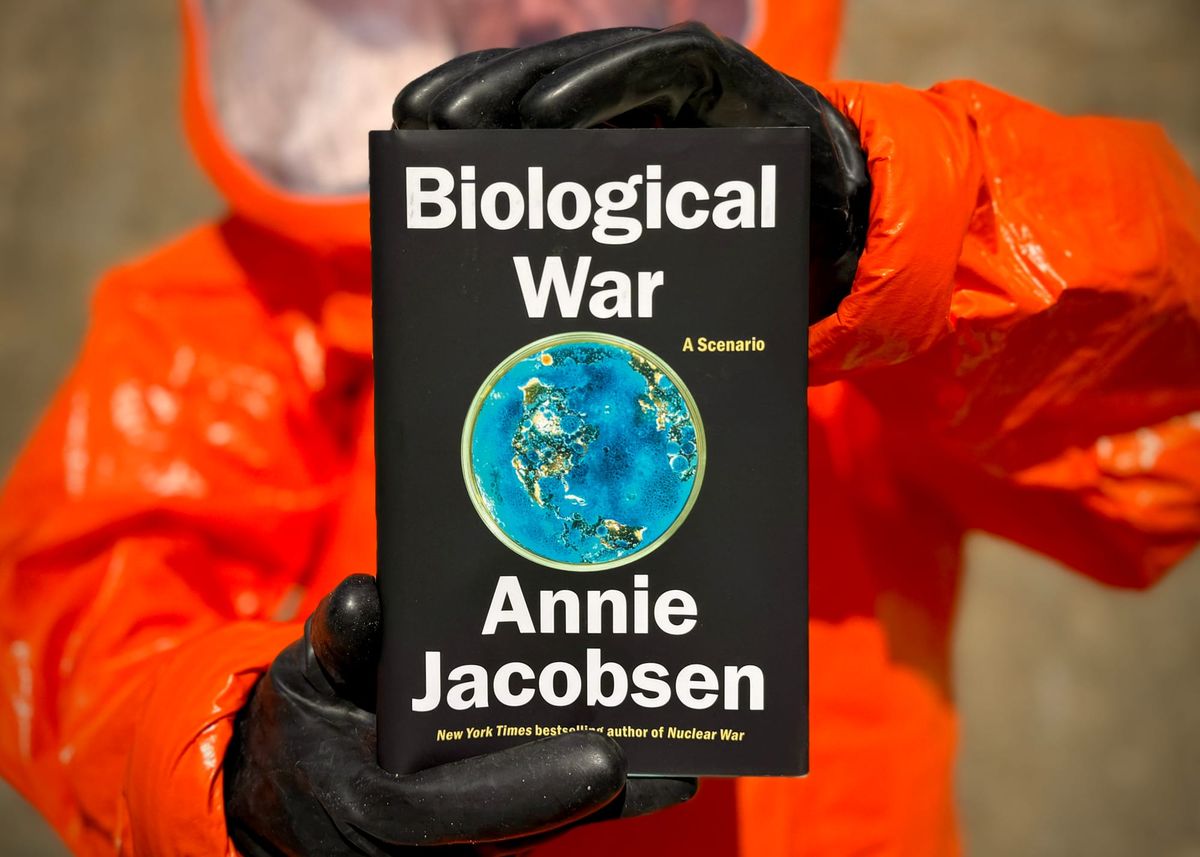
Annie Jacobsen’s Biological War: A Scenario is a frightening look at how ill-prepared we are for a biological weapon attack
There’s an anecdote that I read years ago that stuck with me: President Bill Clinton was so disturbed by Richard Preston's novel The Cobra Event that he began asking senior staffers and policy officials about the nature of the country's defenses against biological hazards.
Preston is most famous for The Hot Zone, a nonfiction thriller that investigated the origins of the Ebola virus, and an incident in which the U.S. Army was called in to contain an outbreak in a population of primates destined for research purposes in a quarantine facility in Reston, Virginia in October 1989. In their book Germs: Biological Weapons and America's Secret War, Judith Miller, Stephen Engelberg, and William Broad recounted that after writing the book, Preston was interested to learn that the military was concerned about Ebola's potential as a biological weapon. He began drafting a novel, and after consulting with experts, landed on the idea of a lone-wolf terrorist bent on thinning out the world's population, mashing together a couple of viruses into a highly-transmissible weapon.
"Clinton was impressed by the book’s grim narrative and apparent authenticity. Preston’s acknowledgments included more than one hundred experts — military officers, intelligence analysts, doctors, scientists, and officials in Clinton’s own administration, including Danzig. The novel’s science, Preston wrote in a preface, 'is real or based on what is possible.'"
Clinton began asking his friends, cabinet members, even House Speaker Newt Gingrich whether they had read the book and what they thought about it. After a White House meeting on another topic, the president suddenly turned to John Hamre, the deputy secretary of defense, and asked whether he could speak to him privately for a few moments. As the two men walked into the Oval Office, Clinton said he had recently read The Cobra Event and asked Hamre whether he thought the novel’s scenario was plausible. Could a terrorist unleash an unstoppable plague with designer pathogens?
 Andrew Liptak
Fiction is a powerful tool for stirring the imagination and gaming out possibilities, and for her latest book, Biological War: A Scenario, journalist Annie Jacobsen takes a look at what the release of a biological weapon might look like. If Preston's novel was enough to get policymakers thinking about it, this should be the equivalent of someone pulling a fire alarm.
Scenario fiction can be a useful tool for policy makers at all levels as a way to take concepts, contingency plans, and policy and see what happens should the worst happen: novels like P.W. Singer and August Cole's Ghost Fleet and Burn-In look at global problems facing the US, while Jeffrey Lewis documents a theoretical nuclear strike against the United States in The 2020 Commission Report on the North Korean Nuclear Attacks Against the United States. Jacobsen tackled similar ground in her 2024 book Nuclear War: A Scenario, in which the US faces a nuclear strike and takes us through how the world ends in a minute-by-minute account that shows how the systems we've set up to speed along the start of a nuclear war will do just that.
Jacobsen sets the stage from the start in her author's note: "Biological warfare is illegal. Biological weapons are illegal. And yet biological weapons exist. The biological weapons that exist include genetically modified weapons designed for hypervirulence and human-to-human transmission. Weapons with a high lethality rate and no known cure."
Her scenario kicks off with a traveler in Frankfurt, Germany who's unaware that he had come into contact with a biological weapon while traveling in Russia. He's in a crowded disco and is spreading the illness to everyone around him.
Four days earlier, a Russian scientist, worried about the implications of their work at the Vector Institute, Russia's premiere biological research facility, attempted to destroy their work and ended up causing an explosion that allowed for the escape of a genetically-modified version of pneumonic plague. This is a particularly nasty weapon, designed to give its victims a sense of euphoria while it incubates inside of them, increasing the chances of it being spread to new victims. As containment in Russia fails, a group of tourists come across a member of the science team and are infected before returning to their respective homes. The countdown begins.
Jacobsen follows the spread of the disease from there: one infected person ends up in a crowded airport in Texas, lands in Los Angeles, and another boards a cruise ship. The results are horrifying: an illness that rages through human bodies, prompting its victims to vomit up blood and necrotized tissue, all while spreading it to everyone around them. The plague rips through the cruise ship like a hot knife through butter, and in Los Angeles, it finds its way into the unhoused populations in Skid Row, where public health officials initially believe that they're dealing with a bad batch of drugs. In the Caribbean, the weapon has landed in the population in the Dominican Republic, prompting an exodus from the island nation that's met with deadly force from US forces in the region.
The situation is quickly spiraling out of control, and while they quickly recognize that the spread of the plague is tied to the explosion at Vector, U.S. officials aren't able to move quickly enough to stop the spread, and are forced to undertake drastic contingency measures, including martial law and devolution to ensure some measure of the continuity of governance. The bioweapon does more than just spread the plague, Just days after the explosion and leak, the U.S. president finds himself isolated in a bunker, unsure when he'll be able to leave.
Jacobsen closes out her narrative on a bleak note: the world has been utterly transformed by this bioweapon. Russia, in its haste to get out a cure, distributed an antidote that kept people safe – but at the cost of horrific birth defects and infertility amongst the remaining population. The survivors in the United States and elsewhere have bunkered down into a series of feudal strongholds in a world reminiscent of the grimmest post apocalyptic thrillers.
The threat that biological agents pose to the country are real and out there. Just days after the terrorist attacks on September 11th, someone began sending packets of anthrax through the mail to a handful of news outlets and US senators Tom Daschle and Patrick Leahy (ultimately killing five people and sickening 17) exposed real gaps in our nation's bio defenses. More recently, our hyper-connected world allowed naturally-occurring pathogens like Ebola and COVID-19 to quickly spread around the globe, where it met a population that was ill-prepared to counter it. As I'm writing this, there's a massive Ebola outbreak raging in the Democratic Republic of the Congo and Uganda.
Margaret Atwood has famously explained that her rule for herself while writing The Handmaid's Tale was that nothing was invented out of thin air: "All of the things I have written about have been done before, more than once." The result is a book that's remained chillingly plausible, decades after it was published.
Jacobsen intertwines her scenario between the events precipitated by her fictional bioweapon with various case studies: overviews of war game sessions undertaken by various government agencies, the response to the 2014 Ebola outbreak that saw several cases arrive in the United States, a 1988 accident in which Russian scientist Nikolai Ustinov accidentally injected himself with Marburg, a 2019 explosion at the Vector lab, a crackdown on marmot hunting over fears of the plague, and explorations of the policies and procedures that govern the responses to biological threats. Jacobsen spins out a fictional scenario, but many of its beats are informed by these real-world events and outbreaks.
 Andrew Liptak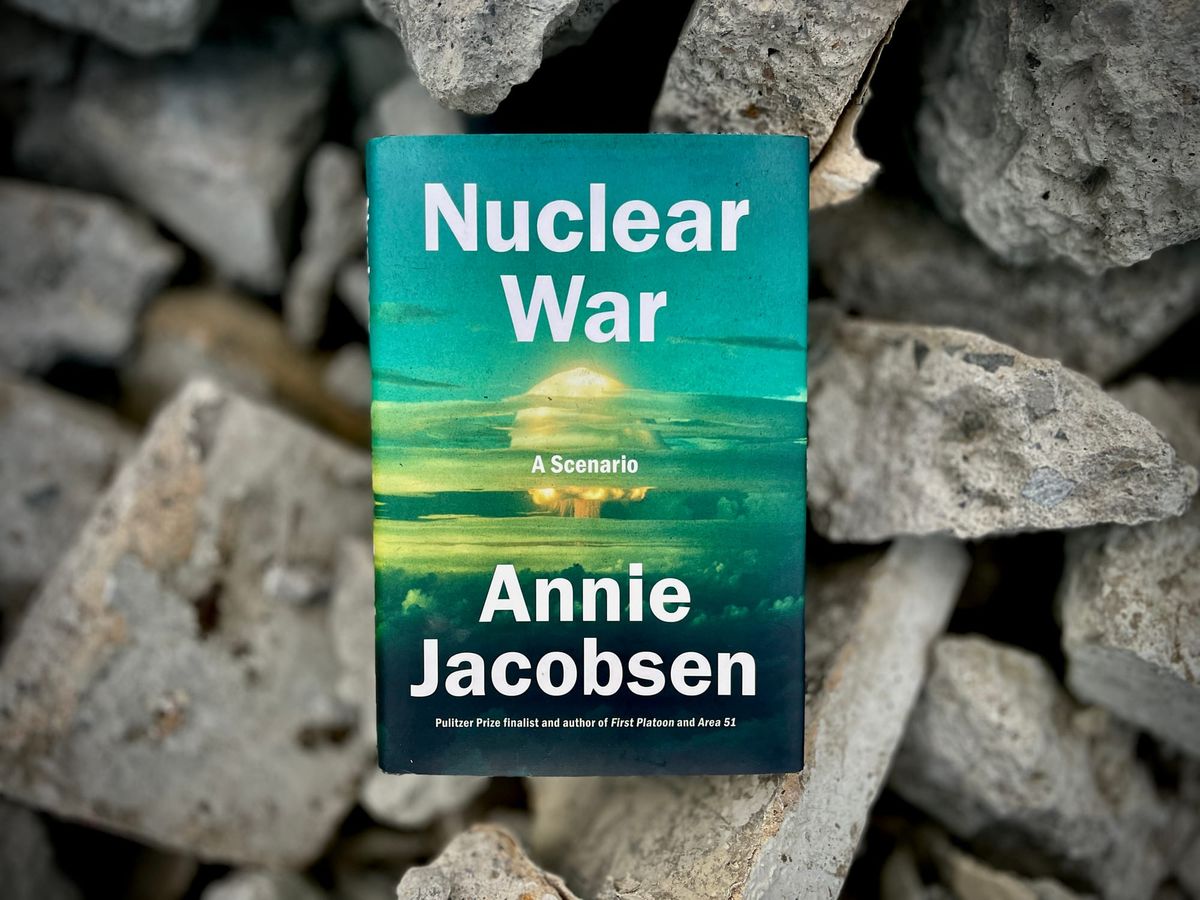
Like 2024's Nuclear War: A Scenario, Biological War looks at how years of decision-making and posture from the US Army and Soviet counterparts have brought about the rise of the environment that now threatens us: while elements of biological war have existed throughout the history of warfare (think back to the possibly apocryphal story of Mongols catapulting infected bodies over castle walls to the US Army distributing smallpox-infected blankets to Native Americans), the rise of the scientific-industrial complex in the 20th century has given rise to a range of new medical advances that can be misapplied for conflict.
Both the United States and Soviet Union researched and stockpiled reserves of biological weapons, until an Biological Weapons Convention of 1972 put steep restrictions on them – something that Jacobsen points out left open loopholes for research and defensive posture. While President Richard Nixon ordered the complete destruction of the country's biological weapons stockpile in November 1976, the USSR continued its work – with Russia possibly continuing the program.
Like nuclear weapons, these types of weapons are designed never to be used – a deterrent in one's arsenal so that it's available to be used if the need arises. It's a familiar argument, but like the massive arsenal of firearms that infests the United States, their mere existence means not only that there's a chance that they can be used intentionally, there's also the chance of an accident. Jacobsen points to an incident that took place in Sverdlovsk, Russia in April 1979 in which an accidental release of anthrax spores led to 68 deaths amongst the local population, and the 2019 explosion at the Vector Lab (in which there was no release of biological agent) as examples of close calls.
 Andrew Liptak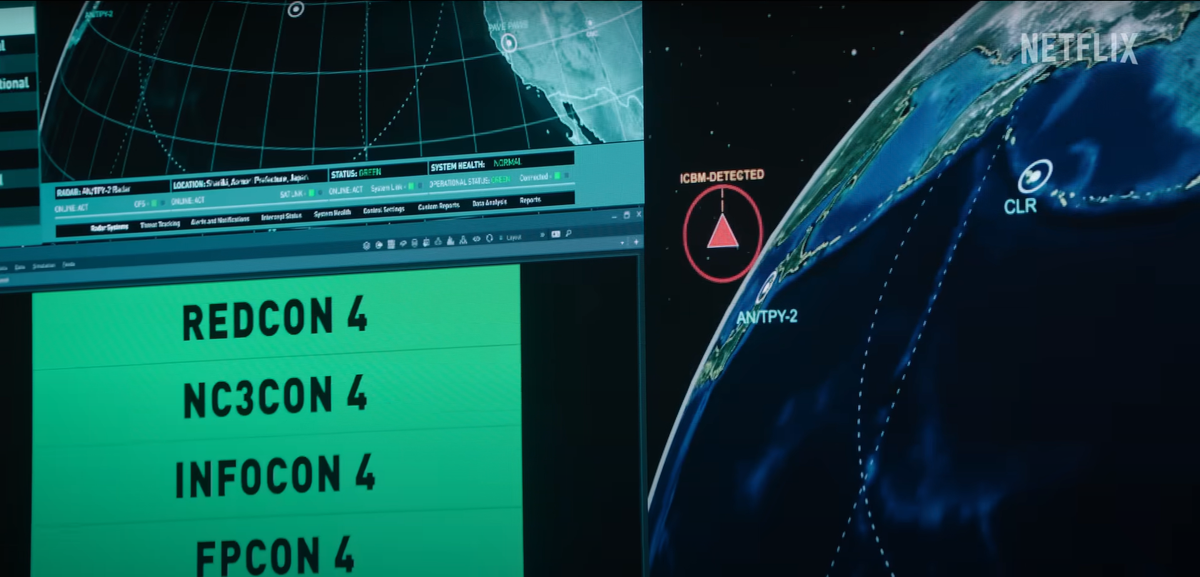
In her prior scenario, Jacobsen examined the role that systems play in the processes to launch a nuclear war. Because nuclear weapons can be launched to their targets in incredibly short amounts of time, the posture of nuclear-armed nations are aligned for a quick response – the end of the world will happen in minutes, because those systems speed the decision-making along so quickly, even in cases of mistakes.
If that book was about how systems work well to ensure a result, this book is about how the gaps and breaks between systems lead to this particular apocalypse. Time and again, Jacobsen points out that biological agents can take days to surface, and when they do, first responders often won't know that they're dealing with a weapon. Initial patients will likely be misdiagnosed, critical information won't be shared between agencies, and by the time governmental officials and leaders understand what's happening, it'll be too late.
There are plenty of instances that stand out: military units trained to respond to biological disasters exist, but it can take houses or even days for them to come up to a readiness so that they can carry out their mission, while disease surveys specifically don't take in data from the country's unhoused populations (already extremely vulnerable), leading to gaps in our awareness about a potential situation. And when authorities do realize something's happening, there are significant bottlenecks when it comes to distributing critical preexposure prophylaxis to first responders and those needed to ensure that civil society remains intact in a crisis.
In Jacobsen's scenario, things go sideways: fast. A massive outbreak in Skid Row leads to confrontations between the population and police, turning into a horror scene that's endlessly played on social media until the internet is shut down. It's only a matter of time before everything breaks, thanks to divisions in civil discourse, a distrust in government, and a willingness to use force and violence against civil authorities. While COVID-19 wasn't nearly as bad as what Jacobsen plays out, we still got a taste of how society would react – not well.
While there's plenty that's shocking in this book – the images of people vomiting and coughing up necrotizing lung tissue is nightmare fuel enough – what's the scariest here is less the blood and gore, but the ease and speed at which this apocalypse happens. An accidental leak leads to the end of the world in a matter of days, thanks to decades of accumulated policies and procedures that we know aren't sufficient to protect ourselves.
The point of the book is clear – to show policymakers and constituents the flaws in our national defenses by throwing everything into the framework of a story, where you can safely show the worst case scenario (or even just a bad-case scenario). Hopefully, it's a book that, like Richard Preston's Cobra Event, will reach the right people and prompt them to not only ask questions about the state of our biohazard defenses, but do something about them. I can only hope that this scary story be more effective at achieving that goal than Preston's was.