Learning the language
Ray Nayler on his fascinating career, communicating with intelligent life, reading and writing unconstrained, and our relationship with the natural world
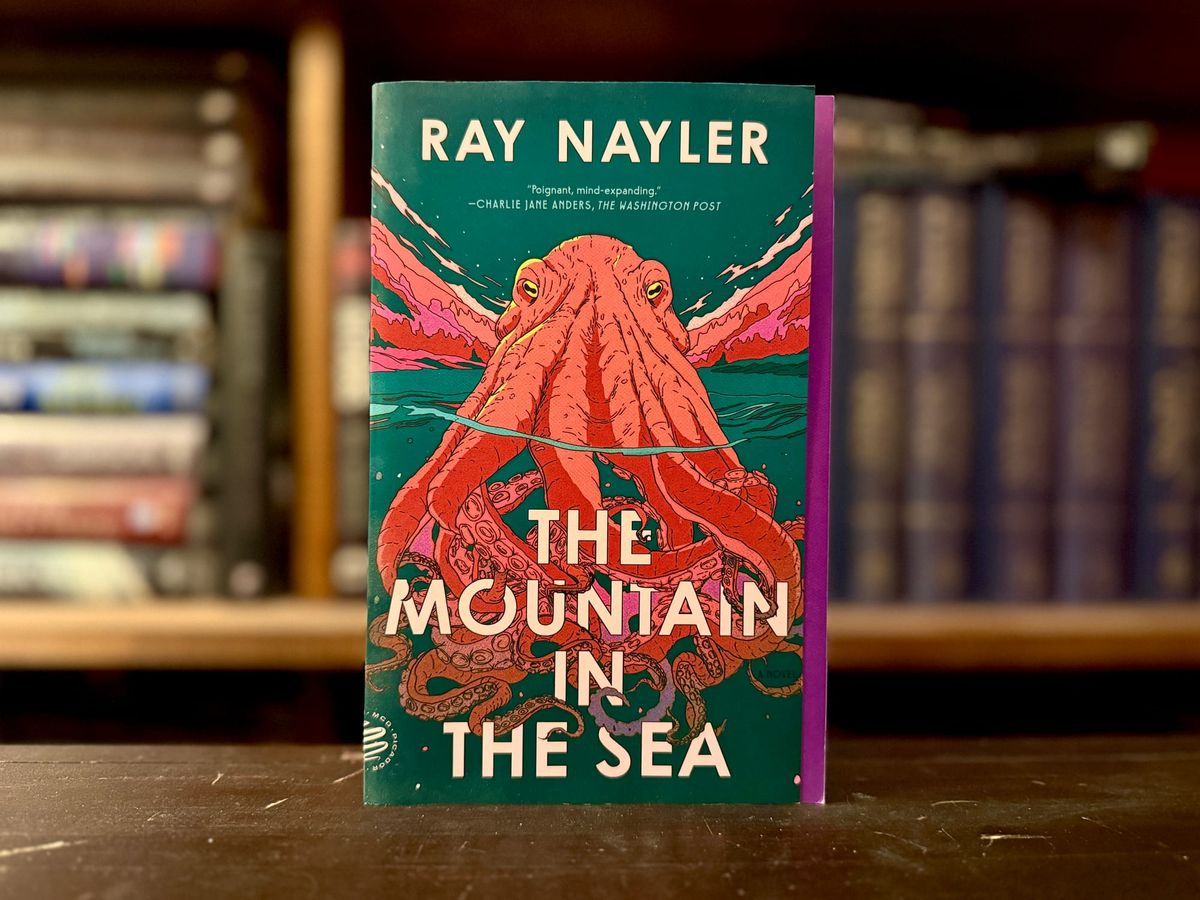
A couple of years ago, I came across a fantastic novel: The Mountain in the Sea, by Ray Nayler. It was a heady book about an emergent intelligence in a population of octopuses off the coast of Vietnam, and a mysterious tech corporation that has been trying to figure out the nature of extrahuman and artificial intelligence.
 Andrew Liptak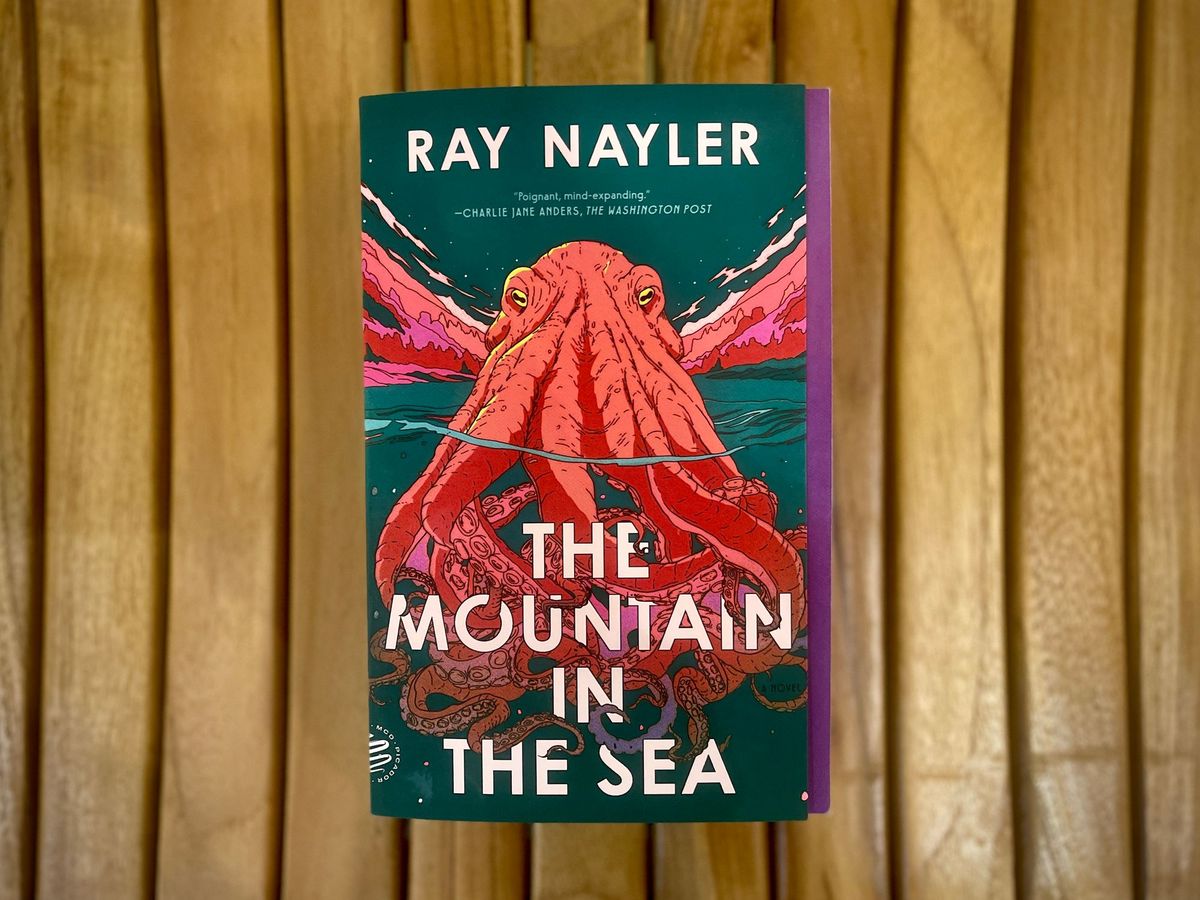
He followed it up with a novella, The Tusks of Extinction (here's my review), and last year's Where the Axe Is Buried, another fantastic exploration of artificial intelligence and how it impacts the world. His next novel, Palaces of the Crow is out this week, and it's one that I'm looking forward to checking out.
After reading The Mountain in the Sea, in 2024, I spoke with Nayler about it, his fascinating background and everything from how we communicate with one another to writing, to genre constraints, and to our role in the natural world.
For technical reasons, it took a little longer to get this interview transcribed, but I'm happy that I was able to figure it out.
This interview has been edited for clarity and length.
To start off, tell me a little bit about your background and how did you come to write science fiction and fantasy.
I started writing, I think as many of us did, when I was a little kid, producing little things. I was also roleplaying when I was younger, coming up with scenarios and writing some of them down, and that lead to writing a few stories about characters and things like that.
I think I started taking writing seriously when I was about 16, when I got it in my head that I was going to be a writer. I started keeping a journal and writing poems and a short story and publishing a couple of things in my high school literary journal and then just kept at it. Back in the days of paper submissions, you know where you got this little piece of paper quite often cut from a larger piece for a rejection? I would just go down to the post office and I would submit to ten different places and then wait for six months quote often that it took or a year or whatever. I kept writing things and sending them out.
Eventually I got published in several short stories small literary magazines and then I got a couple of short stories in Ellery Queen Mystery Magazine. I had started to write some crime fiction and what I could call noir in the late 1990s and early 2000s.
In 2003, I joined the Peace Corps and I went to Turkmenistan, which caused a big break in my publishing, because I couldn't send anything through this complex paper process. There was no way to get a self-addressed stamped envelope and I didn't have an address in the United States. I only came back in 2022, and it wasn't until the rise of digital subscriptions that I was able to actually submit again.
In 2014, I came up with an idea [for a] science fiction story. I thought it was pretty simple: if you lived forever, it wouldn't really make much of a difference, because none of us can remember much about what happened 50, 60, 80 years ago and it seems like human memory has a terminal state that's at some number of decades, maybe ten or twelve. So we would just be kind of drifting, but always be developing: we wouldn't have a thousand years of knowledge, we had a human lifetime or maybe a little more's [worth] of knowledge, and then there would be this horizon beyond which we couldn't remember.
So, I wrote that story, called it "Mutability," and I sent it out to Asimovs, and I got just really lucky: Sheila Williams asked for a pretty minor rewrite of the ending, and then took it. Because I had been published in a science fiction magazine, I started thinking a little more about science fiction stories.
That's it: I just started writing more science fiction and I kept writing. I continue to write mainstream things as well; poems and short stories (I'm writing a mainstream short story right now, I've published a few over the last few years) but science fiction just became more and more of a focus. I think it just happens naturally, because that just became the way you start to think: you feel less constrained by the way things are, and you start predicating on how things might be otherwise, which is just a core element of what speculative fiction writ large is. That's basically it.
Then in 2019, just after my daughter was born, I decided to write a novel, The Mountain in the Sea. I finished it by about late 2020, so about 18 months from start to finish before I felt comfortable sending it off to agents, and then I ended up getting represented by Seth Fishman of the Gernert Company* and published at Sean Mcdonald at MCD at Farrar, Straus and Giroux. It was kind of out of the blue. I wasn't expecting that because I thought the whole thing was going to be a lot harder.
It's the first time in my life that's happened to me and I've been jokingly calling it the 30 years to overnight success story, because it's about what it took.
*Disclaimer: I'm also represented by Seth Fishman.
When you were first setting off to college was your goal to become a writer?
When I was going to university, I thought I was going to be a writer. I was then rejected from the creative writing program and went into the straight literature program. The process of trying to get published over the next 10 or 15 years, I think killed any idea that I was going to be able to be a writer as a profession. But that didn't affect my desire to continue to write and publish. So I just got up in the morning and then wrote, then went to to whatever job I had and I never stopped thinking of myself as a writer, but I did stop thinking of it as a career.
I also saw what writers did in general, that a great number of them taught at universities. I have no interest in doing that. That a lot of people have MFAs, which I had no interest in getting. That they treated writing as a group activity, which I had no interest in. You know, there were there was really very little attraction to the other things around writing that typically constitute what being a professional writer is.
And so once I became a Foreign Service officer, I had a fascinating job that was really interesting to me, where I got to learn new things every couple of years. And, I was constantly moving from one place to another and learning a lot, and I felt that it was really also feeding my writing very well with new information and new ideas and, and so I thought "well, this is, good. I can continue to just be a Foreign Service officer and write on the side and publish in Asimovs and Clarkesworld and get some nice feedback from my work and talk about the things I'm interested in, but I don't have to worry about making money on it." And so that's been good.
Can you talk about about your foreign experience? You joined the Peace Corps and went overseas at a pretty interesting time in the world's history. What was what was your motivation for joining?
So, I went overseas for completely for personal reasons. Basically in 2003, I was in San Francisco after having spent some time in Toronto. I was feeling kind of directionless; I graduated from the university about five years before, but I hadn't any kind of success as a writer, was working whatever jobs I could get along the way. And it's not a lot with a B.A. in modern literature. So I was thinking that I just needed some big change in my life. And so I applied to the Peace Corps. You know, in the interview process they actually ask "Have you had a recent breakup?" And I had, and I lied and said no, because I was afraid they wouldn't they wouldn't take me if they thought I was like on the rebound or something.
Is that something that usually happens?
I think, yes. Yeah, they said that quite often people join the Peace Corps because someone broke up with them and they wanted to just do something drastic. That generally that doesn't work out well for them.
But yeah, I was initially offered a spot in Chad, but I told them that I knew people in Chad, thinking that wasn't a big deal, and they said that that wouldn't work, because I shouldn't know people in the country I was going to. So I had to wait for another assignment, and they ended up giving me Turkmenistan. I almost turned it down, because I looked it up and it was just like there was just very little information about it, and what did exist was just about how it had this very severe dictatorship, it was a really closed country, deserts and all this kind of negative, stuff. I called the Peace Corps and asked them what would happen if I turned this down, and the woman very successfully basically was like, "oh, are you afraid of going to Turkmenistan? Does it intimidate you?" And that got me to be like, "No! I'm not afraid of Turkmenistan, I'm going!"
So I took it, and while I was in Turkmenistan, I learned Turkman first, and then I got to my work place, which was at a university, [where I taught] English. And the English department was an extremely cosmopolitan group of people from all over the former Soviet Union. It was Azerbaijanis and Armenians and Russians and all of these different ethnicities and their common language was Russian, not Turkmen. They said "that's very cute that you speak Turkmen, but almost nobody, especially not in higher education, does. So we're going to teach you Russian."
So I learned Russian and after two years in Turkmenistan, I decided I wanted to stay overseas. I had no desire to go back to the United States at all, and I got a job recruiting for a high school exchange program in Moscow. [I was] traveling all over Russia interviewing high school students, who were interested in spending a year in the United States. It was a program funded by the State Department, but I was working for a contracting organization. Then after that, I went back to D.C. for the same organization, decided that I indeed, as I had predicted, hated it here and wanted to be overseas. I took another job in Kazakhstan, then went to Kyrgyzstan and Afghanistan for them, and then I went back to Moscow for a couple of years.
Met my wife, we got married and moved to Tajikistan, where I took a job as the country director at the office of that company there. We were there for a couple of years and then joined the Foreign Service, actually kind of under duress. The U.S. ambassador, who I used to hike with on Sundays – Tajikistan is like 96%? mountains – so we, we were hiking one day when she said "I think she would make a really good Foreign Service officer, you should take the Foreign Service officer test. We're giving it at the embassy in about a month."
I said, "no, thank you. I really am not impressed by the other Foreign Service officers that I know and it doesn't seem like a good job for me. I like what I'm doing." And then she said, "well, let me put it a different way. The United States ambassador has just asked you to take the Foreign Service officer test, so, I'd like to know when you sign up."
I said "Yes, Madam Ambassador, I will take the test." And I did, and I surprising myself, I passed it. I got into the oral examination, which is the second or third stop, and I pass that too, and ended up in line for an orientation class. My first assignment was Ho Chi Minh City, because in all the wisdom of our system, I guess they decided, since I was a Russian speaker who had worked for so long in the former Soviet republics, learning Vietnamese would not kill me. So they sent me there. That's where I worked a lot on Côn Đảo and got a of the ideas for The Mountain in the Sea.
One of the things I've been most curious about is how life experiences always feed into to writing. So how does work in the international relations arena influenced your writing? What types of things has that experience provided for your writing?
I mean, I think that on the surface, [for] The Mountain in the Sea, a lot of it is about communication between species. It's like this take on the first contact novel, but underneath that, there's just a lot of experience with miscommunication. Cultural misunderstanding, learning a new language and messing it up, trying to to get through all of the things that can happen when you're trying to be understood in a foreign context when you're the foreigner, and when you're trying to be understood in someone else's context. So having 20 years of of that really, I think, informs my ideas about what communication is and how difficult it will be for it to be successful. A big part of The Mountain in the Sea for me just trying to treat first contact the way I thought it had never been treated, which was to demonstrate how actually difficult it would be to understand where another species was coming from, even if that species was from Earth, where we had a little bit of common contact. Just the embodiment of meaning, the difference in culture and environment, and perception. All of those things would just make it nearly impossible to get anywhere.
I think that that's what you get when you spend 20 years trying to even communicate well with other human beings. That's a point that I've made talking in several podcasts that I've done: we have this idea that we could communicate with another species [but] we seem to have suppressed the fact that we're very, very poor at communicating with our own species. Quite often we can't even communicate well with people in our own families, much less people who are from societies that are different from our own. We have difficulty communicating sometimes across gender, across race, across ethnicity. There's so many ways in which human beings are bad at communication and so many ways in which we think we would be good at it if we were just talking to someone else, someone not human.
Diplomacy, like everything, is fraught with misunderstanding and you have to be very, very careful in order to actually communicate successfully with anyone in order to get the word of diplomacy. There's a lot that needs to be done first in just understanding where the other person, because all of these relationships are fundamentally human relationships, is coming from. What's their framework? How do they view the world? How do they view you? There's a lot of ways in which things can go wrong before you even open your mouth.
I attended Norwich University, a military school here in Vermont as a civilian during the early years of the Iraq War. I had classmates vanish for a semester at a time because they were called up and deployed, and some of them recounted that "yeah, we don't really understand anybody over there, and we try to communicate by just talking really loudly and really slowly." Which doesn't work! That just reminded me of how we're really not good at communicating or figuring out ways to do it.
Well, we don't take into account how much is involved in communication. We think things like, for example, if I just have a translator, and I say words the translator says the identical word in their language, then the person who hears those words will understand what I mean.
The example that I like to give is: if we're having this conversation, even if it's not a public conversation and I know it's going to be written down, I might say something as an American like, "well, I don't really get along very well with my mother."
In the American context, that would be seen as like "oh, he's being vulnerable," right? This is something that we talk about as a culture: we sometimes don't get along with our parents, there's a lot of psychotherapy and others things devoted to our childhoods and stuff like that. That's a perfectly normal thing for someone to say, even if those two people don't know each other that well, to maybe talk about how they don't get along with their parents or they had a bad Thanksgiving or something like that.
But if I say those words to Turkman person, what they hear is "this person is a bad person. They don't understand the basics of family loyalty. They don't understand how fundamentally, precious, the mother/son relationship is, and they cannot be trusted with even the most basic things that could ever speak to this person again."
So you see, the fundamental problem here wasn't the words at all. You were just being unaware of the cultural context and what those words were going to mean to the person that was hearing them. That, I think, is what's missing from our knowledge of what communication is. We keep thinking and I don't think of a particularly military way of thinking – it's just common if I have a translator, right? If I have an automatic translator, then my word will be understood as what I meant them to be. And that's just fundamentally never the case.
I was always intrigued when I spoke with people about the effort they would have to go through just to have a conversation, particularly in Afghanistan and Iraq. There's a lot of show – procedure isn't the right word. There's a lot of ceremony? – where you sit down and go through all the motions in order to start to talk about what you want to talk about. Obviously if you're there in a military context, you don't have a lot of time, and people get impatient and baffled at why they have to go through this, while on the other side, they're like "why are you rushing through this? This is how we do things."
In many societies – and another thing that I've learned from and traveling a lot is that we are the strange ones, actually. Most human societies are more like one another than our society is. Like, we are very, very far removed from what it means to most people on planet Earth to be a human being. We have a completely different set of values from the vast majority of other people on this planet, and they quite often have a lot more in common with one another than we have with them.
In most places, when you go into a conversation, you will say as an American. "Okay, Mr. So-and-so, thank you for agreeing to see me today, I would like to bring to your attention X." And the response will quite often be "would you like some tea? How is your family? Are you married? How many children do you have?" All of these things. And the reason is a perfectly reasonable reason: it isn't quite ceremony, it's because this person wants to understand who they are speaking to. They want to put you in context, because context is how you understand people, and they don't want to have a conversation that's out of context, where all you're talking about is transactional things. They want to know who they're speaking with so that they can determine how to respond to you. And we interpret it as being ceremonial, while in fact, it's often investigatory!
There's a reason for this: you want to have a conversation with someone about their family first before you get down to business, because you want to see things like how quick to anger are they, right? How do they talk about people? Are they respectful? There's a lot that you can learn from that initial, round-about seeming conversation. I find that I quite often now in situations like this, I do exactly the same thing. Someone says "Okay, let's get down to business." And I say "tell me a little more about yourself." Right? Because it seems like a perfectly reasonable thing to do, whereas I think we see ourselves as largely being interchangeable and that the conversation we're in as being a transactional conversation. For example: "okay, so you know that I work for the U.S. embassy," "I know that you're the deputy minister." And based on those roles that we're playing in society, we're going to have a conversation, and that conversation is going to be about the business between us. For the deputy minister, what he's thinking is, "who is this person? Not just their rank, but who are they? Are they married? Are they? You know, what are they interested in? Where do they come from? Where were they last?" And then he's going to learn some things about how to deal with you as a person.
Has that trickled over to your writing and has it changed your mindset when it comes to developing characters or the situations they find themselves in?
For me as a writer, what it did was slow me down and get me to think more about what writing and reading are, and think about the relationship that you have with the reader and what you can and can't expect a reader to bring to the table, and then sort of how you're going to go about having this conversation with them. Because it really is a conversation: every opening of a book is a collective act where a writer and a reader tell a story together. Part of that story is in that one reader's head, and the other part is what's written on the page.
It taught me things like if I write a sentence this way and this person doesn't have the background that I have, they may not understand that, right? So maybe I need to be writing in this way. Or how is my how is my writing privileging a certain kind of worldview? What kind of assumptions am I making in my writing? When I present a character and I, do X, what I does that do for someone who's not an American or a European? I think I became a lot more careful about things.
One of the things I think I became very careful about is I generally don't describe most of the characters in my book specifically, because I think that physical description carries with it a ton of cultural assumptions about – what characteristics are supposed to mean. It also invites the connection between physical appearance and mental state and I think that's a false idea, that we have of the way someone looks has something to do with the way they are. And it might, like in the example of The Mountain in the Sea, the way Altantsetseg looks has something to do with how she is. Right? The scarring that she has from the war and her past experiences is important and so she gets described, but most of the other characters don't. Little nuances like that, I think that's how it's gone into the writing, and just a wider sense of who a reader might be.
Talking about The Mountain in the Sea, what was the origin point for that book? How did you settle on octopi – octopus? Octopi? What's the verdict?
Octopuses? There are three different, possible plurals, but they're all incorrect in one or another way. Octopuses is probably the most correct. Octopi is also correct via being the most widely used. There's an argument for all of them and I don't really care about it. Choose one and move on. [laughs]
We'll go with octopuses, then.
I was always fascinated by octopuses. When I was a kid, I did a fifth grade report on octopuses. So it's been a life long affair. I can remember telling people about their cognitive abilities way back in university, just having conversations with friends about them and stuff. So that's kind of always been there, and I've always been fascinated by animal intelligence and other kinds of intelligence. Also by he variety of human intelligence, the different ways in which people can be smart, and conversely, the different ways in which people can be, you know, not smart, although they are very intelligent in other ways. That's always fascinated me, just the variety of minds out there in the world.
Côn Đảo was a place that I worked a lot as an environment, science, technology and health officer when I was at the consulate in Ho Chi Min City, and I got really attached to the place, which was very threatened by overfishing, by poor enforcement of the national park, regulations, by corruption, by all of these other things. I was there for a long time working on projects with some of the youth of the islands and doing other stuff with the national parks and probably all in all I spent a couple of months out there at different times, but I got to know it well.
It's a very small place, really. I got to know it so well that I could, when I was writing the book, I could literally turn my head and see what would be there, everywhere on the archipelago.
And I dove there and at night, so it was a perfect place to use the setting for a book because I just knew it very well. I also loved the way that it resonates with other island narratives, right? The Island of Dr. Moreau and then you've got The Tempest, and you have all of these other books that have (and really many of them are genre books of one kind or another) that have been set on islands. So there was that to play with, and that was very suggestive.
But I think I started thinking about the – I've sort of put those two together when I launched Arrival, and I remember really admiring the movie visually and being really impressed in many ways by it, but thinking precisely what I talked about earlier, that in fact this would be far harder. And it's not like the movie didn't do justice to the difficulty of communication, but I did feel like it just didn't do enough of it. I also thought, "well, what if I went at this in a hard science fiction way?" and really tried to address biology. Like, how would an octopus start using symbols. What would be the adaptations it would make? How would this affect all these other things?
So I kind of put myself in this small box, and it was that constellation of having a good setting, having an animal that I had always been really interested in, and then having this first contact idea and being a little bit disappointed with how first contact is treated overall, and then having seen this really great movie that I thought did first contract quite differently, but also which could have a conversation with. All of those things came together. And then, how do you get that final idea for a novel, I think you just start writing and then it kind of writes itself.
I think the completing moment of The Mountain in the Sea, the point at which I knew I had a book, was Dr. Ha Nguyen was on the island, she wakes up the next day after having this dream again, she goes down to Altantsetseg, and then walks out on the beach, and at this point, I had not determined who the third member of the research team would be. I really had no idea, so I was just writing blind, and then Evrim just sort of rose up on the beach, this AI. That completed for me, the book. I understood that I was going to be able to talk about lots of different ways of being intelligent and lots of different kinds of minds and that's what this book was going to end up being about.
One of the things I liked about that is the ways that intelligence permeates the book in a whole bunch of different ways. Obviously there's the main question of these creatures being sentient and how you communicate with them, but also being able to communicate with Evrim, and Altantsetseg, and then even just how intelligence sort of emerges out of complex systems? How this big corporation that they're working with sort of seems to gain a mind of its own.
The really interesting thing for me about life in general is that – what life fundamentally is, of the things that life does, maybe the most primary thing, is it changes how causality works in the world. So when you have nothing but non-living systems, rocks don't roll down hills because they want to be at the bottom, or because they envision a future in which they're at the bottom of the hill and that's good for them and will sustain them further, right?
But in the moment biological life appears, life forms are always doing things in the service of a future state, right? Meaning, their primary function is survival, right? Even at a minimal level, survival means doing something so that in the future, you will be able to continue doing this thing, and that's a causality reversal that occurs only with life.
But then the other fascinating thing is, once you get these really complex organisms like human beings, when they start forming systems, those systems evolve and imitate life in many ways, so that you get a way in which bureaucracies have the same kind of self-regulating, autopoietic, urge to sustain something for the benefit of a future state. Organizations, corporations, all of these things, acquire equalities of minds and life, because they've been created by living systems, and so they're kind of mirrors of those living systems, and then they start having an effect on the living system that created them. I mean, we're all affected by corporations, and I'm not going to go too deeply into that. [laugh] But I mean, clearly the structure of corporate activity has an effect on the way people live.
And yet, the structure of corporate activity in many ways is life-like in a strange way. Corporations will fight for their own survival, even beyond the people, the individuals who make them up. So I think that's a fascinating thing.
In The Mountain In The Sea, you see these ways in which these big systems imitate minds and life in sometimes really pernicious ways. You can see how environments do this – forests do the same kind of thing. They become larger organisms. Every environment essentially just becomes a larger organism combining the activities of all the organisms within that environment in order to create some kind of a state that has a balance to it. And there's nothing sort of hippie about that, that's really the way biology works!
So yeah, for The Mountain in the Sea, I wanted to build this architecture in which I could ask a lot of cool questions about sentience and about symbols and linguistics and all these things. I'm not particularly interested in many ways in answering any of those questions, because I don't think we have answers yet. It was a really neat way to just ask them in more and more complex ways. And that's kind of what I see science fiction as: this tool that really allows us to ask these complicated what if questions.
Yeah, it's a vehicle for understanding. It's always fun because of how we've imagined talking to one another. Did you ever read "First Contact" by Murray Leinster?
It rings the bell. I'm sure I have, but can you jog my memory?
It's about two spaceships coming across one another in a nebula and they realize that neither one of them can trust each other to turn around and go back home.
Ah, right.
It feels like this trope has gotten a lot more complicated as time has gone on, and we now have a more nuanced understanding for how languages and communication work.
I think that's one of the fascinating things about a genre in general, the intertextual conversation that's always happening within it. The conversation over time, I think, like any conversation does, gets more and more sophisticated, and I think about how it's sort of like two people who barely know each other: they initially start talking about some topic and start at a pretty basic level, establishing the fundamentals of their beliefs. Then they move on to more and more complex things as they come to understand one another and the context that they're in. Once you've known someone for 20 years you can get engaged in all kinds of super complex conversations with that person.
I feel like genre is kind of like that: all of the books in a genre are in conversation with the readers of those books and with the historical sort of positioning of those things and we have this wider context, which is also really fun to play with as a writer, because you can make reference to it and you can expect certain things from some readers. Although my cautionary part of me tells me that many people aren't aware of that tradition, they may not have read those things, and if you're relying too much on tropes, then you can be leaving some people really out in the cold, especially your non-Western reader who may not be as versed as someone who grew up with science fiction. So there's other ways to do this too, to tie up to other things.
I'm always reluctant to see this as linear progression. But I do think there's this way in which science fiction becomes increasingly complex. And I think one of the reasons that this particular first contact narrative becomes increasingly complex is because it's pulling in and opening itself up to more voices, which are complicating and decolonizing that narrative of first contact and are seeing it from the many different perspectives that it's taking place in. I think that's what the really wonderful thing is: science fiction becomes increasingly complex, the more of humanity it's able to speak with as a genre and as its brain and the human frame widens, these these ideas also become more sophisticated in this really wonderful feedback loop.
I appreciate you saying that you have to be sort of cognizant of not leaving people behind. I have this sort of love-hate relationship with fandom and genre in the idea of books being in conversation with one another, because that means in order to be fully engaged in that conversation, you need to be part of it from almost beginning, which is almost impossible to do.
I wonder about these things. I think in general, and it's not about science fiction at all, but in a general sense, I don't think people should be fans of things so much. I think there's a distortion that occurs in the brain when you become a fan of a thing too much. And I'm very suspicious of this tendency, which I also find very American – peculiarly American – to become a fan of a thing, and then like an authority on that thing and a limiter of what that thing can be or look or sound like.
It seems like a lot of fandoms just become a way of putting up barriers between very fertile fields. I'm trying to create definitions of things that are themselves kind of undefinable or defy those definitions and have arguments over where the boundaries of things are. And I think that's a really unhealthy thing.
But I want to pause it in reverse, so you don't think that this is just something about fandom. I think it's wonderful to love a thing – to read a book and love it, tell other people about it, talk about it, be enthusiastic about it, and have a connection to it. I think that's a wonderful wonderful thing. But I would like to really see less of a world in which people say extraordinarily stupid things about genres that they don't themselves like.
I've heard far too many science fiction fans, grouse about literary fiction and pretend that literary fiction is limited to only one or two basic topics when in fact it's a vast and wonderful field! And vice versa, there are so many great reviews of The Mountain in the Sea that I really love, where a perfectly intelligent person starts their review with the stupidest possible opening phrase – you probably know what it is:
"It's good, but it's science fiction."
Yeah, it's generally like, "I don't usually read science fiction...but," right? And of course, the thing that they're not realizing is the very fact that they have read a science fiction novel that they believe is of quality proves that they ought to be reading science fiction with a much more open mind. So they're already with something of value that they were missing out on by making this choice to judge things according to this compartment. And then, the converse thing is that a lot of the beating up on books comes from within fandom and they're beating up on their own people, they're beating up on the writers writing for them!
In a lot of ways, I think that there's like fandom and then there's like canon fandom, where you're trying to put everything into neat boxes. One of the things that always drives me nuts is "how do we make sure that these stories are completely rectified and we know exactly how they fit together into neat a neat box." I think canon in a is itself a limiting thing for a creator.
I agree, and I would say, "let's just come to a place where we can have a great love of things without limiting what other things can be." Like, we can love the things that we love about Star Trek without trying to define what can and can't be done in the future with that set of troops or getting angry or hurt when things are done in a way that isn't the way that we want.
I think that's what's really strange about it: the feelings of betrayal and hurt that come with offended fandom. That just seems, it just seems odd to me and it seems so limiting. What I don't want have come out of this is to have it come out that I don't think it's good to love things or even be obsessed with them: I think that's great, and I think they're truly engaging with things like Star Trek. I mean, it's an endless and very fruitful world that they've come up with. It's fun to talk about, and it gives you a framework to discuss all kinds of really cool things, philosophical and political and all sorts of stuff.
I don't know, I think the thing that bothers me is when anyone says "I don't like this entire category of thing." Because of because of my ignorance or stereotyping about that category of thing. Anyone who says that, if you question them about why, they will give you a straw man. "I don't like science fiction because of the science fiction straw man." It just fundamentally reduces science fiction to something it's not.
And it's usually just an this outdated vision of what science fiction can do. If you look at the crop of books that are out there now there's some really extraordinary works of literature!
And like literary fiction, thank God, the vast majority of it are not books about a professor having an affair with his students! That's the sort of stereotype – only maybe one in a thousand or fewer of mainstream novels is about this thing that I've seen come up about what mainstream fiction is about!
I was literally about to crack that joke.
Yeah, exactly! So we all have our completely outdated stereotypes. By the way, that novel is Stoner [by John Williams], and if you don't like that, don't read that book! [laughs]
I just think that anything that narrows someone's ability to experience the world is a bad thing, and I think that reading widely is wonderful for people and they should never put anything out of reach. For me, one of the things that's difficult for is knowing everything about science fiction is simply that it only constitutes maybe 5 to 10% of what I read. I read a lot of non-fiction. I read a lot of mainstream fiction. I read a lot of short stories in all genres. Read a lot of poetry. I read whatever I want, and whatever I'm interested in, and I've never felt constrained by genre, and I feel the same with writing. If I want to write a horror novel next, I will.
What are you reading right now?
Let's see. So right now I am rereading short stories by Amy Hempel, who is a really wonderful short story writer. I'm also reading a collection collection of short stories by Lydia Davis, who I also think is just a fantastic short story writer. Reading a really complicated book about applying systems theory to media (II forget what the title is because I've just just started it and it has one of those long academic titles.)
I do read a lot of academic and theoretical stuff and I read a reasonable amount of philosophy because I need it for the underpinnings of my own work. But I ground my way through some of that stuff and some of it's very enjoyable, some of it's not.
I'm also okay with this thing where you read 500 pages of something and it helps you to understand an idea better, but it's not, like, good or enjoyable. It just makes you smarter, and I'm okay with that kind of reading too.
But I'm also okay with just – okay if you want a good recommendation that I can give everyone, I read this book Between Two Fires (by Christopher Buehlman). It's a horror novel set in medieval France during the 100 Years War and it's fantastic. Like, just fantastic, just so well written, so brilliant. I loved it so much. I think a lot of people would dismiss it as being just a piece of entertainment, but I just thought it was so good.
So you know, I read it all.
Both The Mountain in the Sea and Tusks of Extinction deal with humanity's relationship with the natural world, and I'm curious, as someone who's traveled a lot overseas and you've seen some of this firsthand, I'm curious what was the sort of thing that radicalized you here? Not radicalized, but what got you interested in exploring our relationship to nature?
I don't know if it's any one thing. I think it's been something that's built in me over a period of time, but maybe the thing that – if want to talk about something that radicalized me, I think that's actually a pretty good way of putting it in some ways.
I think it was the birth of my daughter, and thinking, "why would it be acceptable for us to make a world that's worse for our children through our own like actions or inactions? Why would we think it was okay to use resources in such a way that the world is going to be crappier after we'd left it for the people that came afterwards?
As a parent, the question I just keep asking myself "I'm going to die. My daughter will as well, and so will, if she has children, her children, and her children's children. Things from our generation will remain and the last few generations – and it's really just a few, right? – since like the 19th century, that has severe and lasting consequences. And the question that I keep asking myself is, "are we being good ancestors?"
I think we're not, and I don't think that we're gonna be forgiven, and we shouldn't be. We're making bad choices as a species, very selfish choices. We're enjoying ourselves a lot at the expense of this planet.
And it's not everyone. It's not all, seven billion of us, but some of us on the top, including both of us on this phone call, and everyone else who's probably capable of reading the interview that out of it are privileged enough to be pulling resources out of the planet at a greater rate than we're entitled to. That shouldn't make us feel bad: it should make us want to do something about it.
I don't think that guilt is useful. I think what's useful is this basic idea of responsibility. The best way I can put it is: it would be great to lay the blame on previous generations, but in the 1950s, they still really didn't understand a lot about what chemicals and other things were doing to the environment and what the results of carbon pollution were going to be. And now we do, and that changes the ethics in a way that I think is pretty obvious. The best way I can put it is, let's say you're walking down the street, someone is in distress and is dying and you walk past them.
Well, it's very different if that person is dying in a place that you cannot see and you're not aware of having walked past them. They're obstructed from your view, and you don't know that it happened. Then you walk by them and they die, and you're not ethically responsible for that death, because you didn't know.
But we're not in that situation anymore. The person in the 1950s didn't understand what coal is going to do to the atmosphere. Now that person's dying. We see them. We know it's happening and we're walking past them, and now we are ethically responsible for our actions because we have knowledge. That's just the thing that bothers me: how can we continue to act in the same way that person acted, who walked past the thing they didn't know about, and pretend like that's okay.
So that's really it. It was becoming a father that pushed me, to really start thinking about this more than I already was.
One of the things I took away from books like The Expanse or from Kim Stanley Robinson was this idea of how our biology limits our viewpoint. That our brains are wired so that we can really only see what's right in front of us, and not the big picture. As we've become this globalized civilization and who knows, maybe an interplanetary one, the problems and complications that come from that are just so vast that we have trouble comprehending the problem itself, let alone solving it.
That's a really good way to put it. Another way to think about it is that we are an experimental species. We are the first species that has become capable of symbolic communication on the level that we have it. The first one that's been able to write down everything from previous generations and past knowledge on in this incredibly elaborate and dense way, from one generation to another to attain this kind of mastery over a whole planet and its ecosystem. The jury is still out as to whether that kind of intelligence is good. And we have not proven that it is – yet.
I hope we do. But the way things are going, it's not looking like this experiment has purely fantastic results. I mean, some of it's amazing. Every week, my daughter goes to a little Saturday school, and my wife and I go to the museum. The things that human beings have done are extraordinary. Art and literature and all those things are amazing.
But then, the other things, you really start to wonder if nature just didn't go one step too far. And it's quite possible that nature will pull it back, that we will outdo ourselves in some way, and this planet will be reduced back to organisms that can't do the things that we did to it.
Something will rise up and try and learn from our mistakes.
Maybe the octopus, right?
I've noted before that these types of in-depth conversations are what I really love to do with this newsletter: I feel like I learn so much from them. But they take a lot of work to put together.
Interviews are tricky and there's a deceptive amount of work that goes into them: you have to first do your background research, read up on a subject's work, then figure out what to ask them. Once you've had the conversation, you have to take that text file and transcribe it so that it's presented to the reader in a readable format. Often, that's removing "ums" "you know"s "kind of"s, and those sorts of things, lightly fix sentences or clarify what someone's wording was, all while retaining their original intent and meaning.
This interview took a long time because of technical issues: a file that was very low in volume, a transcription that didn't quite work, and a long conversation that was well over 12,000 words when all was said and done.
So: if you like and appreciate these interviews: consider leaving a one-time tip (or subscribe as as supporter!) or by going to the bottom of this post to the SHARE button and by sharing it to your friends / family / followers.
Thank you: every little bit helps.
Thanks for reading, and huge thanks to Ray for this chat (and his patience in getting it out to y'all.) Let me know what you think in the comments.